

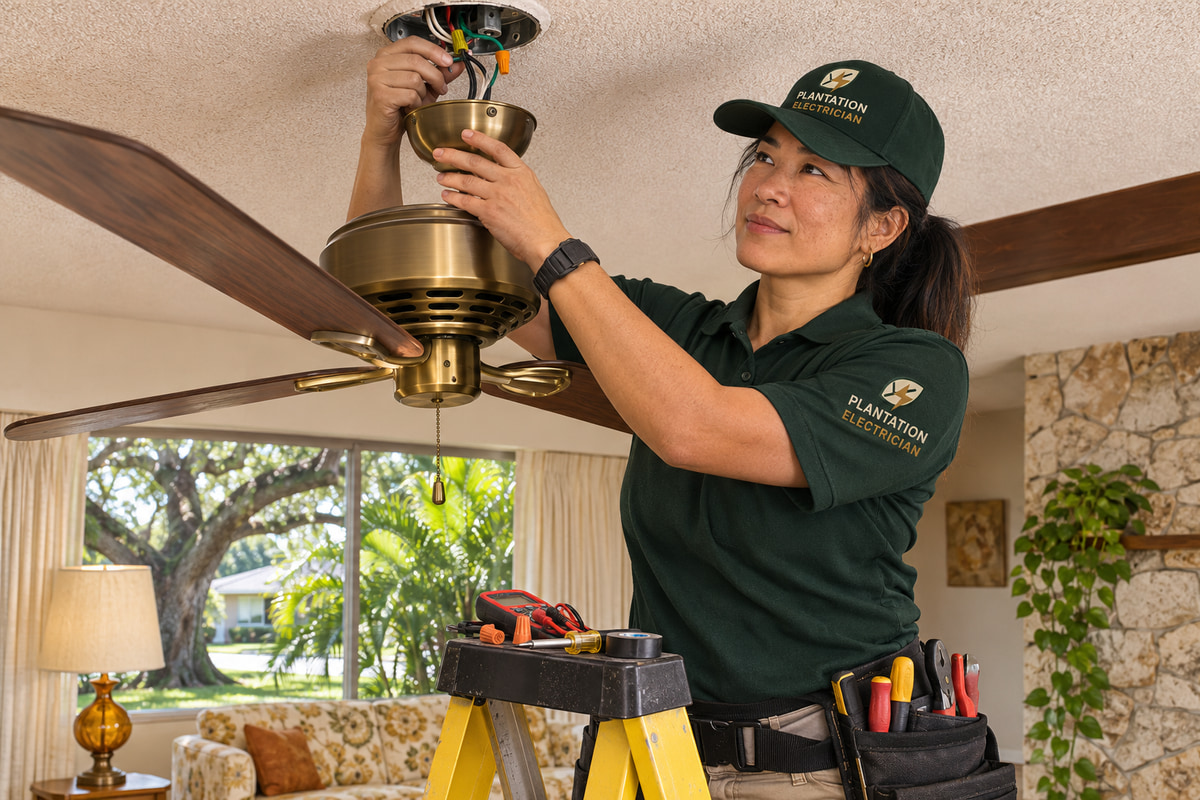
A measured, orderly standard of work
Electrical work is one of the few trades where a quiet job done well is the best possible result. When the wiring inside a house or an office suite is correct, nobody thinks about it. Lights come on, equipment runs, and the breakers stay where they belong. Plantation Electrician was organized around that idea. Our aim is not to impress anyone with noise or speed but to leave behind electrical systems that behave predictably, that can be understood by the next person who opens the panel, and that were explained to the owner before a single wire was touched.
That standard begins with listening. A client who calls about a tripping breaker, a dim hallway or a request for new circuits is usually describing a symptom, and the symptom rarely tells the whole story. We ask where the trouble appears, what else was running at the time, how long it has been going on and whether anything about the building has changed. Those questions are not a formality. In a house with decades of additions and repairs behind its walls, the answer often sits in a detail that the owner did not realize was important, such as a bathroom that was extended, a garage that was converted, or a kitchen that gained appliances the original wiring never anticipated.
From there we separate what we know from what we are assuming. Many electrical conversations go wrong because a guess is presented as a diagnosis. We try to avoid that. If a problem can be identified from a description, we say so and explain why. If it cannot, we say that as well and describe what would need to be opened, measured or tested to be certain. A fair and accurate quote depends on that honesty, because pricing a job on an assumption that turns out to be wrong serves nobody.
We think of professionalism as a set of small, visible habits rather than a slogan. It means arriving with a clear understanding of the job and respecting the property while working in it. It means protecting floors and furniture, keeping the work area orderly, and cleaning up at the end of the day instead of leaving debris for the owner. It means labeling a panel directory so that every circuit is identified in plain words, because a panel with vague or missing labels is a small hazard waiting for an emergency. It means explaining what was done in language a non specialist can follow, and answering the follow up questions that come after the work is finished.
We also believe in knowing the boundaries of a job. Some questions belong to the city permit office, to a building inspector, to an association board or to a property owner who has the authority to approve changes. We do not pretend that those decisions are ours to make. When a project involves a permit, an inspection or an approval from a landlord, we describe how that part of the process generally works and what the client should expect. Code questions are always worth confirming with the appropriate authority, and we would rather say so plainly than imply a certainty we do not have.
Safety is the thread that runs through everything. Electricity gives little warning, and the hazards in an older building are often hidden: a connection that has loosened over many summers, insulation that has dried and cracked, a ground path that was never completed, or a device that has been quietly running warm for years. A good electrician reads those signs. Part of our work is simply noticing, and then telling the owner what we noticed in a calm and proportionate way. We do not use fear to sell work, and we do not dismiss a real concern to keep a job small. The goal is to present the facts and let the owner decide with a full understanding of the choices.
Communication does not stop at the end of a visit. If a project will take more than one day, we describe in advance what will be shut off, for how long and what the household or business needs to do to prepare. If the scope changes because something unexpected is found behind a wall or above a ceiling, we stop and discuss it before continuing. Surprises are a normal part of renovation and repair in older buildings, but they should never arrive as an unexplained line on a final bill. Our practice is to talk first, adjust the plan together and then proceed.
Finally, we value restraint. Not every problem needs a large solution. A worn receptacle may need only a new device. A flickering light may be a loose connection at a single fixture. A tripping circuit may be an appliance that has reached the end of its life rather than a flaw in the house. Where a modest repair is the honest answer, we say so. And where a deeper upgrade such as a new panel, additional circuits or a staged rewiring is the sensible path, we lay out why, what it involves and how it can be sequenced to suit the owner's budget and schedule.
Clients sometimes ask what separates one electrical contractor from another when the work looks similar on paper. In our experience the difference shows up in the details that do not appear on a quote: how clearly the plan was explained, whether the panel was left tidier than it was found, whether the owner knew what to expect on each day of the project and whether the questions were answered without impatience. Those details cannot be advertised convincingly. They can only be demonstrated one job at a time, and that is how we prefer to earn the trust of the people who call us.
It is also worth saying what we do not do. We do not promise a price before we understand the work. We do not describe a job as simple until we have seen enough to know that it is. We do not recommend replacing equipment that can be safely repaired, and we do not leave a questionable condition unmentioned simply because it falls outside the original request. If we see something during a visit that the owner should know about, we will say so, even if it means the conversation takes a different turn than either of us expected.
The homes, streets and buildings of Plantation
Plantation is a city of established character, and that character shapes the electrical work we are asked to do. Much of the residential area grew during the middle decades of the last century and in the years that followed, and the streets show it. Mature trees shade many blocks. Rooflines, driveways and block walls carry the look of the era in which they were built. Yards are generous in some neighborhoods and tidy and compact in others. Beneath that familiar surface, the electrical systems of many homes reflect the expectations of a different time, when a household ran far fewer devices and the idea of a dedicated circuit for a charger, a dehumidifier or a home office was not yet common.
Homes from the 1960s through the 1980s are the heart of our residential work. Houses of that period were built with the materials and practices of their day. Many have panels sized for a lighter load than a modern family places on them. Some still have receptacles without a ground connection, and some have fixtures wired in ways that were acceptable when installed but that deserve a second look today. Homes from the early 1970s may contain aluminum branch wiring, which behaves differently from copper at connections and calls for careful attention. None of this means a house is unsafe. It means the house has a history, and an electrician who understands that history can help the owner decide what to update, what to monitor and what to leave alone.
Construction style matters as much as age. A large share of South Florida homes are built with concrete block walls and plaster or stucco finishes, and the attics above them can be shallow and hot. Running new wire through such a house is a different exercise from working in a wood frame building with open cavities. It takes planning to find routes that avoid unnecessary damage to finished surfaces, and it takes patience to fish cable through spaces that were never designed to be opened. When we discuss a rewiring project or a new circuit, we talk about access honestly, because it affects both the method and the amount of patching and painting that may follow.
The climate adds its own layer. Heat and humidity work on electrical equipment year round. Outdoor fixtures, pool equipment and lanai outlets face moisture, and connections in a hot attic age faster than those in a cool room. Afternoon storms bring lightning, and the grid itself switches and surges in ways that stress sensitive electronics. Hurricane season brings the question of backup power and the equally important question of how to connect a generator safely so that it never feeds power back toward the lines that utility workers may be repairing. We approach each of these topics as part of ordinary home maintenance rather than as something exotic.
Within the city, different areas carry different characteristics. Plantation Acres, on the western side, is known for larger lots and a more open, semi rural feeling. Properties there may have detached structures, long driveways, gates, workshops or outbuildings that need power well away from the main house. That raises practical questions about feeder cable size, voltage drop over distance, wet location protection and how a separate panel should be arranged. A job in the Acres can look very different from a job on a compact street closer to the center of town, and we plan accordingly.
Elsewhere in Plantation the picture changes again. Tree lined residential streets near the older core feature homes whose original service equipment may be due for review. Established neighborhoods close to the main roads often sit beside commercial centers, so that a household and a small business may share the same block. Newer communities toward the west include more recent construction with different layouts and different expectations. We try to avoid treating the city as a single uniform market. Each street has its own typical housing, and each housing type has its own typical electrical questions.
Two roads define how many people think about Plantation: Sunrise Boulevard and University Drive. Sunrise Boulevard carries traffic east and west through the city and is lined in parts by shopping centers, restaurants, service businesses and professional buildings, with residential neighborhoods tucked just behind them. University Drive runs north and south and is home to a notable concentration of office parks and medical offices, alongside retail and apartments. Businesses along these corridors have electrical needs that are distinct from those of a house, and we treat them as a separate discipline rather than as a larger version of residential work.
A medical or professional office, for example, depends on stable power in ways that a typical home does not. Computers, phone systems, diagnostic and treatment equipment, refrigeration for supplies and lighting that supports detailed work all need reliable circuits. A panel in such a space has to be organized so that the people who manage the building can identify what feeds what. A tenant improvement may require new lighting layouts, additional receptacles at specific locations, a data closet with its own power and a clear plan for how loads are balanced. Interruptions are costly, so scheduling often matters as much as technique, and work may need to happen around business hours.
Retail and restaurant tenants bring other concerns. Signage, display lighting, point of sale equipment, kitchen loads and emergency lighting all have to be accommodated in a space that may have been wired for a very different previous occupant. Property managers and landlords have their own interests as well, such as keeping shared equipment in order, documenting changes and making sure a tenant's work does not create problems for neighbors in the same building. We try to understand both sides of that relationship and to communicate with each of them clearly.
Plantation also contains a good deal of multifamily and mixed use property, along with older apartment buildings and small commercial buildings that have been renovated several times. Those buildings tend to contain layers of past work. An electrician opening a panel in such a place may find circuits added in different decades by different hands. Part of our job is to make sense of that layering, to identify what is sound and what is not, and to recommend a path that improves safety without demanding more than the situation warrants.
Because the city sits among several neighbors, we also see how conditions shift just beyond its borders. Communities to the east, north and south have their own mix of mid century houses, condominiums and commercial strips, and many of the lessons from Plantation carry over. We serve nearby Broward County communities with the same approach, adjusting for local housing types and building age. The city pages on this website describe those areas in more detail, and the guides explain common electrical problems in language meant for owners rather than specialists.
Understanding a place is part of doing the work well. It would be easy to describe every house the same way and every office the same way, and to apply one standard answer. We prefer to ask what kind of building we are in, when it was likely built, how it has been changed and how the people inside actually use it. Those answers tell us what is likely to be behind the wall, which problems are probable and which are unlikely, and how to approach the job with the least disruption. In a city as varied as Plantation, that curiosity is not a luxury. It is a basic requirement of competent work.
What it is like to work with us
A first contact can happen in two ways. You can call the number shown on this website, or you can use the form on the contact page. The form sends the details you enter to the business so that we can reply, and it is a convenient choice when your question is not urgent. Either way, the first step is a conversation. We would like to understand what you are seeing, where it is happening and what you hope to accomplish. A short and honest description is enough. You do not need to know the technical name of a problem to describe it well.
Quotes are given by phone when the work is straightforward enough for that. Replacing a failed switch, adding a ceiling fan to an existing box or discussing a charger circuit in a garage are the kinds of topics that can often be guided over the phone, with the understanding that final details depend on what is found on site. Larger or more complicated jobs begin with a visit to the property. Panel replacements, rewiring, circuits that must pass through finished walls and commercial buildouts all fall into that group. Seeing the building allows us to give a quote that reflects real conditions instead of a best guess.
We do not promise a price in advance of understanding the work, and we do not promise a specific arrival time. Electrical work depends on access, on the condition of what is found and on the order in which tasks must be done, and we think it is more respectful to say so than to offer a number we cannot stand behind. What we can promise is clear communication. You will know what is planned, what may change the plan and what each stage of the work is meant to accomplish.
Preparation helps. Before a visit, it is useful to clear access to the panel, to the area where the work will happen and to the attic or crawl space if one is involved. If you have noticed patterns, such as a breaker that trips only when the air conditioner starts or a light that dims when a particular appliance runs, write them down or take a short note on the phone. If you have the paperwork from previous electrical work or from a home inspection, bring it out. None of this is required, but all of it can shorten the diagnosis and reduce the chance of a second visit.
For homeowners buying or selling an older house, we can describe what a whole house electrical check generally looks at and what the findings mean in plain language. That includes the service entrance, the panel and its labeling, the condition of visible wiring, grounding and bonding, protective devices in kitchens, baths and outdoor areas, smoke and carbon monoxide alarms, and the general condition of fixtures and receptacles. The purpose is to give a clear picture, not to alarm anyone. Many older homes have items worth attention and also have a great deal that is perfectly sound, and a good report distinguishes between the two.
For landlords and property managers, we aim to be a dependable point of contact. That means describing work in terms that can be passed along to owners, tenants and associations, and being clear about what falls inside a tenant's space and what belongs to the building. It also means respecting that a tenant has a business to run and a landlord has a property to protect, and that the two are not always in agreement. We try to keep the work moving without taking sides.
If something goes wrong, the first priority is safety. A burning smell, visible scorching, smoke or sparking is a reason to move people away from the area, to turn off power only if that can be done safely and to contact emergency services. After everyone is safe, call us and describe what happened. Water around electrical equipment, a panel that feels hot or a main breaker that will not stay on are also situations to treat seriously. We will help you understand what to do while you wait, and what the repair is likely to involve once the situation is stable.
We also encourage questions that arrive long after a job is finished. A new circuit may behave in a way you did not expect, a light may need adjusting or a month later you may simply wonder whether something you noticed is normal. A good working relationship does not end when the invoice is paid. We are glad to explain, to confirm that something is ordinary or to look at it again if it is not.
The guides on this website exist for the same reason. They are written to help owners recognize common electrical problems, understand why they happen and decide what to do next. Reading them does not replace a visit from a qualified person when one is needed, and they are not a set of instructions for doing hazardous work yourself. Their purpose is to make you a more informed participant in decisions about your own building, so that when you do call, you can describe the situation clearly and judge the answer you receive.
Our commitment is simple to state. We will listen before we recommend, explain before we begin and tell you the truth about what we find. We will treat your property with care, keep our promises about communication and avoid claims we cannot support. Whether you own a house on a quiet street, manage an office suite along University Drive or oversee a small retail space off Sunrise Boulevard, we want you to finish the project understanding your electrical system better than when you started.
If you are considering an electrical project in Plantation or a neighboring community, we invite you to browse the services, the city pages and the guides, and then to reach out through the contact page or by phone. Tell us what is on your mind. We will take it from there, one clear step at a time.