

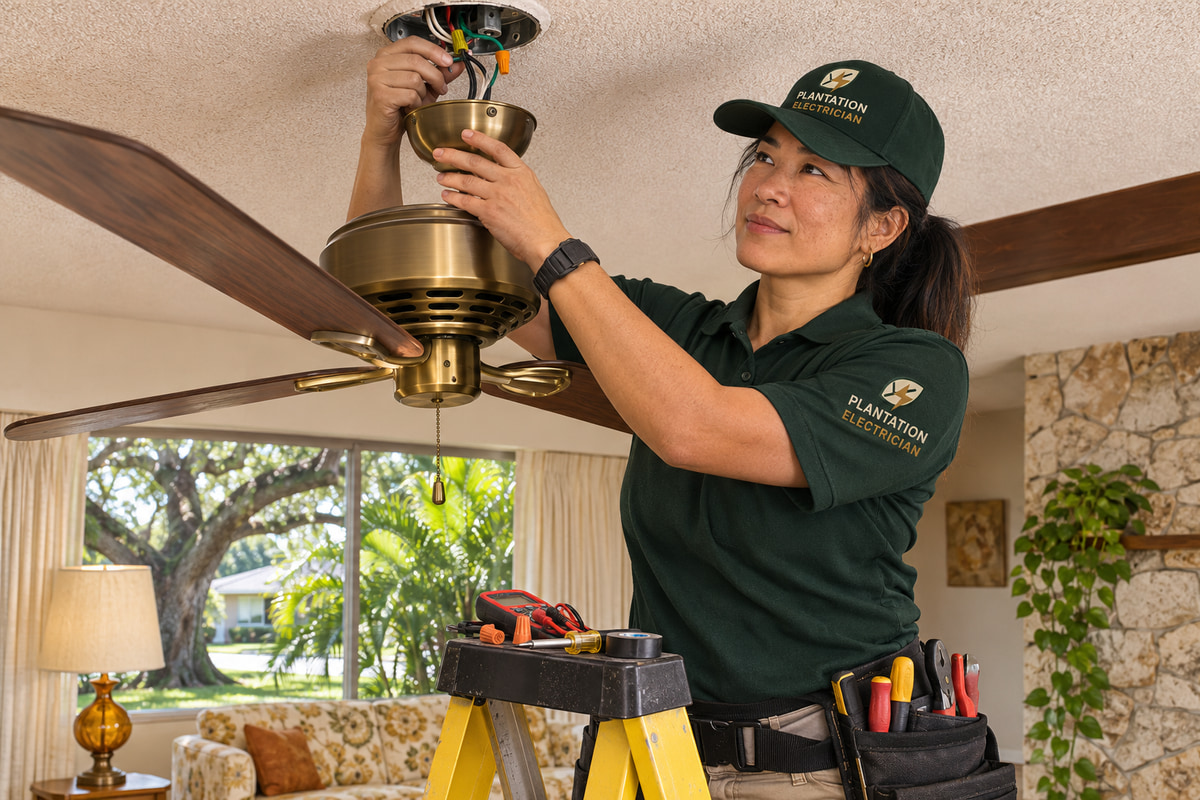
A park neighborhood where the houses are older than the habits
Plantation Central Park has athletic fields and a pool, and the streets around it include established mid century homes under large shade trees. That combination tells an electrician a good deal before the first visit. The houses were built in an era of smaller electrical expectations, and they have been lived in by families whose habits have changed around them. The wiring that was once more than enough for a modest household now serves phones, laptops, streaming boxes, window units turned into central air, microwaves, air fryers and more.
Neighborhoods around a park have a particular rhythm. Weekends bring activity: games, practices, gatherings. Many residents entertain, host relatives in town for a game, or run a yard sale on a Saturday. Neighbors know one another, and word of mouth about who did good work on a street spreads quickly. People often stay for decades, which is good for the neighborhood and means houses accumulate generations of small electrical changes, some done well and some not.
That history is the main theme of this page. When you buy or inherit a mid century house, you also inherit all the choices that previous owners made about the wiring. Some added a circuit for an air conditioner and did it carefully. Some ran an extension from a nearby outlet to a garage or a back room and left it buried in a ceiling. Some replaced fixtures without checking what was behind them. An honest first visit often involves discovering these layers one at a time, and discussing which ones need attention.
The houses themselves are often single story ranch layouts or similar, with attics above and slab foundations below. Wiring commonly runs through the attic and drops into walls. This is helpful because attic access makes many repairs and additions possible without opening finished walls, though Florida attics are hot and cramped and work in them requires care. The slab foundation means that anything run underground or in the slab, such as old conduit or buried cable, is hard to reach, so a plan for new work usually goes through the attic or along exterior walls.
Trees are the other character trait. Large shade trees cool yards and add value, and they also affect electrical systems. Roots reach for moisture, branches contact service lines, and falling limbs in storms damage service masts and weatherheads. A house under old trees should be checked regularly at the point where the utility connection meets the home.
What mid century wiring looks like and how it ages
Wiring from the middle of the last century and the decades that followed is mostly copper, and much of it has done its job well. The aging story is less about the metal and more about the materials that surround it and the devices attached to it.
Insulation on older cable can become stiff and brittle, particularly in hot attics, and it may flake when disturbed. Disturbing old cable is the main risk of renovation: pulling, bending or moving it can crack the insulation and expose the conductor. An electrician working in an older attic moves carefully for this reason and often chooses to replace short sections where damage is found.
Old receptacles lose their grip with use. The springy contacts that hold a plug become loose, and a loose plug makes a poor connection that heats up. A receptacle that feels warm, smells of hot plastic, or has a cracked or discolored face should be replaced without delay. Switches that click weakly, fail to hold, or buzz are in the same category.
Two slot outlets without a ground are common in the earlier part of this age range. They accept two prong plugs only, and many families have used adapters to fit three prong plugs into them. An adapter does not provide a ground unless it is attached to a grounded box, which these usually are not. Sensitive electronics and appliances that expect a ground are better served by a proper grounded circuit, or at least by a ground fault protected receptacle that is labeled as having no equipment ground, which improves shock protection.
Panels in this age group might be fuse boxes, early breaker panels, or later panels installed during a remodel. A fuse box is not automatically dangerous, but it limits capacity, and the temptation to put in a larger fuse than the wire can handle is a known hazard. If a household replaces blown fuses with ones of a higher rating to stop them blowing, the wire may overheat. Replacing the panel and addressing the overloaded circuits solves the cause.
Some mid century houses also include features that look odd to a modern eye: ceiling junction boxes without covers, cloth wrapped wires in places, cables spliced in walls with tape instead of in boxes, and old doorbell transformers wired in questionable ways. Finding these does not mean the house is a disaster. It means the work should be planned with care.
An informal checklist for homeowners can help.
- Are there outlets that only accept two prongs?
- Does the panel use fuses or breakers, and are any fuses larger than the circuit calls for?
- Do any plates feel warm or look discolored?
- Do lights dim when large appliances start?
- Are extension cords doing permanent duty?
- Has anyone added circuits without a permit or documentation?
A yes to any of these is a reason to ask for an inspection, not a reason to panic.
Yards, mature trees and power outdoors
Large shade trees define the yards in this neighborhood. They create pleasant spaces for sitting, and they also create specific outdoor electrical needs and risks.
Start at the service entrance. The point where the utility line reaches the house, via a mast and weatherhead on an overhead service or a conduit and meter base on an underground one, is exposed to the elements. On a house with mature trees, branches may rub against the service drop, leaves may collect in the weatherhead, and moisture may seep behind the meter base. Signs of trouble include a loose mast, a drooping or chafed cable, rust or stains around the meter base, and a gap where the conduit meets the house. Only the utility can work on its side of the meter, and a licensed professional should address the homeowner's side. If you see a limb on the service line, do not touch it and report it to the utility.
Outdoor receptacles under trees get splashed by drip lines and collect debris. They should have in use covers and ground fault protection. Landscape lighting, popular in neighborhoods with tall trees because it can uplight trunks and canopies, calls for weather rated fixtures and well made splices. Low voltage systems are simple and safe when properly installed, but the connections at the fixtures are vulnerable to moisture and root growth.
Roots can reach conduit and cable buried in the yard. If you plan to plant a tree, dig a pond, or install a fence, find out where the buried lines are first. Calling the state one call service before digging is the standard step, and it covers utility lines. Private lines, such as a feed to a detached garage or a pool, are not marked by the utility and should be located through records or an electrician's tracing equipment.
Sprinkler systems add controllers and valves with low voltage wiring. A controller on a garage wall plugged into a shared outlet may lose its program after outages; a surge protected outlet and a battery backup help. Valves that stick or leak sometimes cause ground faults in adjacent wiring.
Trees also affect where solar or additional equipment might be placed, and how well pool equipment performs. These are questions for another day. The point here is that a yard under trees needs a design that respects roots, shade, drip and fallen leaves.
After a storm, walk the yard and look for damage before turning on outdoor circuits: cracked fixtures, cables pulled from the wall, covers knocked off, or standing water around equipment. If a breaker for an outdoor circuit trips right after a storm and will not reset, there is likely moisture inside something, and the circuit should stay off until it is inspected.
Gatherings, game days and lighting the yard well
Living near a park with fields and a pool means weekends that feel social. People host backyard gatherings, birthday parties, and cookouts. They set up speakers and string lights, run extra refrigerators from the garage, and borrow extension cords from every corner of the house. Gatherings test a home's electrical system in a way ordinary weeknights do not.
The first rule for gatherings is to know what your circuits can carry. A typical outdoor receptacle shares a circuit with other outlets, sometimes including garage lights and outlets, and sometimes the lanai. Plugging in a blender, a speaker system, a pop up lighting display and a second refrigerator can exceed what that circuit was built for. A breaker that trips partway through a party is doing its job. A more durable answer is a dedicated outdoor circuit, or a second one, with protected receptacles placed where you need them. Doing this once saves a lot of extension cord clutter.
String lights are a good example. Outdoor rated strings with sealed sockets suit the climate, while indoor strings degrade quickly in humidity. Hanging them on hooks rather than stapling them to wood prevents damage to the insulation. A power adapter and timer keep the display from running all night. For permanent installations, a switch inside the house and a weather rated outlet at the right height tidy up the setup.
Speakers, projectors and televisions for outdoor use should be plugged into protected outlets with covers that keep rain out. Long runs of extension cord across wet grass are best avoided; if you must use one, choose outdoor rated cord of a suitable gauge for the load, and keep connections off the ground.
Security and safety lighting matters when guests come and go after dark. Pathway lights, step lights and a bright but shielded fixture at the gate or driveway reduce trips and stumbles. Motion activated lights deter unwanted attention and save energy. In a neighborhood near a busy park, considerate lighting that keeps light on your property and out of neighbors' windows is appreciated.
If your property is close to the park, you may also deal with traffic on game days. That is not an electrical issue, but it does raise the value of reliable porch and driveway lighting, and perhaps a camera or doorbell setup. Those devices need power and a good network connection; low voltage doorbell transformers, often old, may not supply what a modern video doorbell needs. Replacing a failing transformer is a small job with a big effect on reliability.
Finally, think about the pool, if you have one. Pool lights, pumps and heaters require specialized wiring and bonding, and any tripping or tingling around a pool is serious. Turn off the pool equipment and call for help; do not swim until it has been checked.
Kitchens, baths and the rooms that changed over time
Inside established houses, the rooms that have changed the most are usually the kitchen and the bathrooms, and those are also the rooms where wiring most often falls behind the way the room is used.
A kitchen from the middle of the last century was often small, with a couple of outlets above the counter and a single overhead light. Today the kitchen is a work center with a microwave, coffee maker, toaster oven, air fryer, mixer, blender and charging area. Even if the kitchen has been remodeled, the underlying wiring might have been left in place and patched. Check whether the counter outlets are on more than one circuit, whether they are protected by ground fault devices, and whether big appliances like the dishwasher, disposal and refrigerator each have their own circuits. A kitchen remodel is a perfect moment to correct these, since walls and ceilings are open.
Lighting in kitchens has also changed. Under cabinet lights, recessed fixtures and pendant lights above an island provide layered light. Each needs a plan for switching and dimming. Fluorescent boxes that hum and flicker can be replaced with efficient fixtures that make the room feel new.
Bathrooms in older homes often have a single overhead light, a switch, and an outlet that may or may not be protected. A modern bathroom may want a dedicated circuit for the outlets, a vent fan with a humidity sensor, a heat lamp, and mirror lighting. The fan matters in this climate because moisture lingers; a fan that moves air to the outside is better than one that simply recirculates. Make sure fan ducts do not terminate in the attic, where moisture feeds mold and damages wiring.
Laundry areas, often in a garage or a utility closet, need a dedicated circuit for the washer and a 240 volt circuit for an electric dryer. Water leaks in laundry areas are common, so ground fault protection is valuable there.
Bedrooms are where aging wiring and arc risk intersect. Cords behind beds, fans on dressers, and window air conditioners in some cases create loads and bends that the original wiring did not anticipate. An arc fault breaker is an extra layer of protection there.
Home offices are the newest addition to many houses. A spare room that used to be a bedroom now has computers and monitors that need clean power and enough outlets. Instead of a power strip daisy chain, consider adding outlets on a circuit that is not shared with air conditioning or heavy appliances. A surge protector at the point of use and, if the equipment is important, a battery backup, are worth the small cost.
A sensible order of work for an older home
When a house has many small issues, the question is where to start. A good sequence usually follows risk.
First, anything that is an immediate hazard. This includes scorched or melted devices, a panel that is hot or smells burnt, exposed wiring, outlets that spark, and any signs of water in electrical equipment. These come before everything else and deserve prompt attention. In an emergency, such as smoke or fire, get out and call emergency services first.
Second, protection. Make sure the places where water and electricity meet have ground fault protection: kitchens, baths, garage, outdoors, laundry. Consider arc fault protection in bedrooms and living spaces. Install or check smoke alarms and carbon monoxide alarms, which are powered by the home's wiring in many houses or by batteries that need regular replacement.
Third, capacity. Examine the panel and the main service, and decide whether the home needs more capacity for existing and future loads. Add circuits where overloaded ones exist. If you plan to add an electric vehicle charger, a larger air conditioner or a generator connection, include them in the plan now.
Fourth, comfort and convenience. Updated lighting, additional outlets, ceiling fans, dimmers, and outdoor lighting all improve how the house feels. These are the visible changes and the most fun, and they go more smoothly when the hidden work is already done.
Fifth, record keeping. Photograph the panel directory, keep permits and receipts, and note where new circuits and disconnects are. These records help when you sell and when the next repair comes.
When you call, mention that the house is older and describe what you have noticed. A quote follows a conversation, and anything involving the panel, rewiring or new circuits benefits from a visit first. If you are working with a budget, say so. A staged plan with each stage finished and tested is a legitimate way to improve an older home, and it keeps the house livable throughout.
Finally, remember that older does not mean doomed. Many houses of this type have decades of service left once the weak spots are corrected. The aim is to keep what is sound, fix what is not, and make sure the whole system can safely carry the way you live today.
A short worked example makes the point. Suppose a family buys a single story house and the inspection report notes two slot outlets in three bedrooms, a panel with no spare spaces, and a garage outlet with no protection. A sensible plan does not try to fix everything in one weekend. It might begin with ground fault protection in the garage, since that is quick and addresses shock risk. Next comes a panel with more spaces, which opens the door for new circuits. Then the bedroom wiring can be handled one room at a time, with protective breakers and grounded outlets, scheduled around the family's routine. At each stage the work is tested and the panel directory updated, so the house is always in a known state.
What we see most often around the park
Homes near the park tend to bring a similar set of requests.
- Outlet and switch replacement. Loose, warm or discolored devices in mid century rooms.
- Grounding and protection. Adding protection where two slot outlets remain.
- Panel review. Fuse boxes and older breaker panels that no longer match the household.
- Outdoor circuits and lighting. Protected outlets, string lighting and path lights for gatherings.
- Service mast and meter base. Checking the point where tree limbs and weather do the most damage.
- Kitchen and home office circuits. Splitting loads that outgrew their wiring.
Other areas close to the park
Plantation Central Park is not far from Heritage Park and the Fig Tree Lane area, whose long established streets are described on their own pages. The Peters Road area, with its ranch style homes, and the Sunrise Boulevard corridor, with its commercial centers, are also nearby. Choose the page that matches your street.