

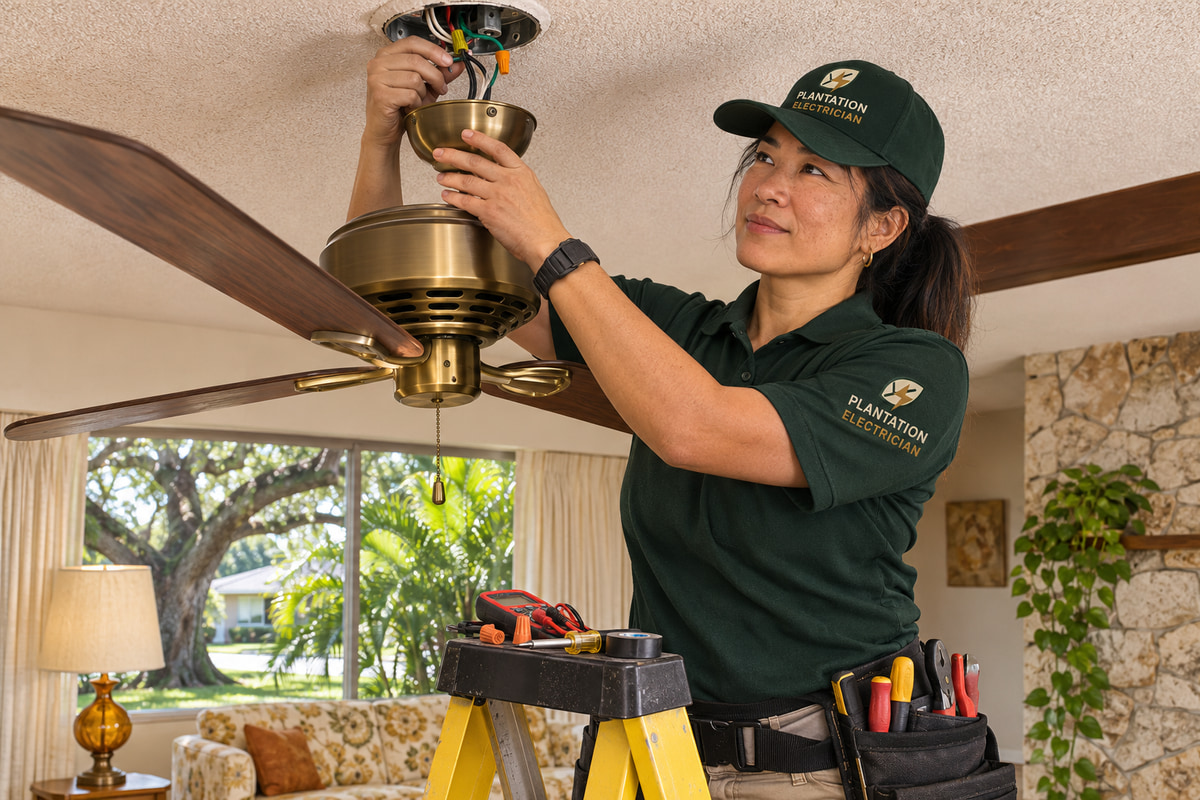
A historic street and the neighborhoods that grew beside it
Fig Tree Lane is a historic Plantation street, and Heritage Park lies along it. The neighborhoods nearby date from the mid twentieth century. When people describe an area this way, they usually mean that the houses have personality and the yards have been growing for a long time. For an electrician, the same description signals something more specific: a good chance that the original electrical system is still part of the house, adjusted and patched over decades by whoever owned the place.
The pattern is familiar to anyone who works on established homes. A house is built with a certain number of circuits for the appliances of its day. A later owner adds a window air conditioner and runs a heavier cable for it. Another owner finishes the garage into a room and extends a circuit across the ceiling. Another replaces the kitchen cabinets and leaves the old wiring behind the new walls. The house works, but the wiring diagram in its walls no longer matches any drawing, and sometimes no longer matches the labels in the panel.
This page is about living with that reality. It does not say that older homes are unsafe. Most are not, and many have excellent bones. It says that older homes deserve the kind of electrical attention that newer homes may not need for decades. That means looking at the panel, testing the outlets, examining the attic, and listening to what the household has noticed.
The neighborhoods near Fig Tree Lane are characterized by tree lined streets and mature yards. That matters for electricity in several ways, which later sections cover. It also matters for the practical sequencing of work: you cannot trench through a root system the way you can through bare ground, and you do not want to disturb a tree you love to run a line to the garage.
A final framing idea is the difference between repair and renewal. Repair fixes what is broken now: a dead outlet, a tripping breaker, a flickering light. Renewal replaces systems that are reaching the end of their useful life before they fail: a panel, a run of old cable, a service mast. A good plan for an older home mixes both, giving priority to whatever puts people at risk and spreading the rest over time.
Reading the signs that wiring is aging
Wiring does not announce that it is wearing out. It sends small signals, and part of an electrician's job is helping homeowners recognize them. Here are signs worth noticing in an established home.
- Lights that dim or flicker. A brief dim when the air conditioner starts is common, but lights that flicker constantly or dim with ordinary use suggest loose connections or an overloaded circuit.
- Warm or discolored plates. Heat at an outlet or switch means resistance, usually from a loose connection or a device that is wearing out.
- A burning smell. Never ignore it. Turn off the affected circuit and have it examined. If there is smoke or flame, leave the house and call emergency services.
- Buzzing or crackling. Sounds from outlets, switches or the panel indicate arcing or loose parts.
- Breakers that trip regularly. A breaker that trips under normal use points to overload or a fault; resetting it again and again is not a fix.
- Outlets that do not hold plugs. A plug that falls out of a worn outlet is making a poor connection.
- Fuses that blow often. In a fuse box, repeated blowing means overload or a fault, and replacing the fuse with a larger one is dangerous.
- Shocks or tingling. Any shock from an appliance, fixture or outlet is a reason to stop using it until it is checked.
Some signs are visible only to someone who looks inside. Cable insulation that crumbles when touched, connections discolored by heat, corroded terminals, scorch marks on the inside of a box, and splices made outside of boxes are all things an electrician finds during an inspection.
One of the most important diagnostic ideas is that the problem is rarely where the symptom appears. A light that flickers might be caused by a loose neutral connection at a junction elsewhere. A dead outlet might be fed by a different outlet that is on the same run and has come loose. Tracing the circuit from the panel through each device is how real causes are found.
It also helps to know that not all aging is equal. A loose outlet is a cheap and quick fix. A brittle cable in the attic is a larger job. A failing panel is the largest. Triage matters. A reasonable approach is to fix hazards first, then handle devices that are worn but not dangerous, then plan for larger renewals on your schedule.
If the household has several symptoms, keep a short log with dates and notes: which room, what was running, what the weather was doing. Patterns appear in a log that are invisible in memory, and an electrician who sees the log can often find the cause faster.
Working around landscaping that took decades to grow
Few things frustrate owners of established homes more than the thought of a trench cutting across a lawn full of mature plants. Good planning can often avoid that, and when it cannot, it can minimize the damage.
The first strategy is to avoid trenching altogether. Many additions can be fed from the attic or through existing wall cavities. A circuit for a new outlet in a garage, for example, can sometimes run through the attic and down a wall, leaving the yard untouched. Wireless or low voltage solutions can supply some outdoor needs, such as lighting, without line voltage runs.
When trenching is unavoidable, careful routing helps. A route that follows a driveway edge, a fence line, or a bed already due for renovation spares trees and shrubs. Hand digging near roots protects them, since cutting a large root can harm or destabilize a tree. Directional methods that bore underneath a root zone are another option for the right situations. Depth and protection requirements for buried conduit are set by code, and the electrician should confirm what applies.
Before any digging begins, underground lines must be located. Calling the state's one call service gets utility lines marked at no charge to you in most cases, but private lines such as feeds to detached buildings, sprinkler wires, pool lines and landscape lighting are not marked unless you or your electrician can locate them. A sketch of known lines from previous work, or a locating tool, reduces the risk of cutting something important.
Landscape materials matter too. Mulch beds, pavers, ornamental plantings and irrigation heads are all easy to disturb. Before work, walk the route with the electrician and mark what should be protected. Tarps for spoil, boards for wheelbarrow paths and careful backfilling preserve the yard.
Equipment placement is another consideration. An outdoor condenser, a generator inlet, a pool panel or an electric vehicle charger needs to go somewhere. A spot with a clear working space, shelter from direct water and a short run to the panel is ideal, but not always possible. Trees overhead can drop debris onto equipment, and roots can lift slabs. Talk about placement before deciding.
Tree work and electrical work sometimes need coordination. If a branch near the service line needs trimming, call the utility or a qualified tree service; do not attempt it yourself. If an electrician needs access to the service mast and a limb is in the way, schedule the tree work first.
Lastly, remember the seasons. The wet season complicates digging, and soggy ground makes trench work messier. Dry months are friendlier for outdoor projects, while storm season suggests having backup power plans in place before you need them.
Heat, humidity and what they do to wiring over time
Florida's climate is hard on electrical components, and homes of this age have been through many long summers. Understanding what heat and humidity do helps explain what you find when a wall or attic is opened.
Attic temperatures in summer can climb well above outdoor temperatures. Cable that runs there is heated every day for months. Insulation on older cable dries, hardens and cracks. When it is disturbed, it may crumble. Fixtures and boxes in the attic, especially those buried in insulation, run hotter than their designers expected. Over decades, this accelerates aging.
Humidity brings moisture. Moisture does its work slowly: corroding terminals, rusting boxes, oxidizing copper, and fostering mold on organic materials near wiring. Corroded connections have higher resistance, which generates heat. In coastal areas, salt in the air speeds corrosion further, though Plantation sits inland and the effect is less than at the beach. Still, humid air moves into every wall cavity.
Condensation is another concern. Where cold air conditioning ducts pass through hot attics, water can condense on duct surfaces and drip onto whatever is below, including junction boxes and cable. A drip onto a box can corrode it or short a connection. If you find water stains on a ceiling near a light fixture, treat it as an electrical matter as well as a plumbing or air conditioning one. Turn off the circuit, and have both aspects checked.
Outdoor equipment bears the full burden. Meter bases, disconnects, condensers and exterior receptacles are exposed to sun, rain and temperature swings. Rubber gaskets harden, plastic covers become brittle and crack, and metal enclosures rust. A visual check of every outdoor box twice a year is a worthwhile habit.
Lightning completes the picture. Florida summers bring frequent thunderstorms. A strike close to a house can send surges through wiring, cable lines and pipes. Surge damage often shows up as dead devices a day or two later, or as electronics that fail without explanation. Whole house surge protection and point of use protectors reduce the risk.
For owners, the practical lesson is to inspect the parts that live in the heat and wet, replace what has aged, and use materials rated for the environment. For electricians, it is to expect more wear than the age of a house alone would suggest, and to choose methods that suit the climate: sealed boxes, corrosion resistant fittings, proper support for cable, and attention to ventilation of recessed lights.
Appliances that arrived long after the wiring was run
The mismatch between old wiring and new appliances is the root cause of many service calls. A house built when the typical home had a few lamps, a television, a refrigerator and a stove now supports an enormous number of devices.
Central air conditioning is the biggest. If a house began life with window units or a smaller system and later got central air, the circuit for it was added to the panel by someone at some time. Replacing a tired system with a larger or more efficient one can change the electrical requirement. The breaker size, wire gauge and disconnect all need to match the new unit's nameplate. A unit connected to undersized wire will overheat it.
Kitchens come next. Microwaves, dishwashers, disposals, refrigerators with ice makers, and countertop appliances like air fryers each put demands on the system. Counter circuits must be sufficient for the number of appliances that run at once, and ground fault protection is important near water.
Laundry equipment, including electric dryers, needs a 240 volt circuit of adequate size. An older house with a gas dryer or no dryer may need a new circuit if the family switches to electric.
Electronics have multiplied. Computers, routers, televisions, game consoles and chargers produce a steady drain, and many families end up with power strips behind every piece of furniture. This is a clue that outlets are too few. Adding outlets where they are needed is safer than chains of strips.
Electric vehicles are the newest arrival. A home charger needs a dedicated circuit with enough capacity to charge a vehicle in a reasonable time without overloading the panel. In older homes, the panel may lack the capacity or the spaces, and the garage may be far from the panel. Planning ahead lets you choose a good location and size the wire for possible future upgrades.
Pools and spas, workshops, home offices, and backup generators have their own needs. A pool pump and heater, for instance, require dedicated circuits and bonding. A generator connection requires a transfer switch or interlock to prevent back feeding the grid.
A simple exercise can help: list everything you plug in that is more than a lamp. Note the wattage or amperage on the nameplate if you can find it. Add up what could run at the same time on each circuit. This often shows exactly where the overload lies and what a new circuit would relieve.
There is also a quieter category of equipment that arrived after the wiring: low voltage devices. Thermostats, doorbells with cameras, smart locks, garage door openers, security sensors and network cabling all run on small transformers or batteries, and they often get installed by whoever is handy. An old doorbell transformer that was fine for a chime may be too weak for a video doorbell, which then reboots or loses its connection. A thermostat that needs a common wire may find the cable in the wall has no spare conductor. A garage door opener plugged into a ceiling outlet may share a circuit with the freezer. None of these are dramatic, yet each is a reason a house feels unreliable. Checking the transformer rating against the device, running a new low voltage cable where a spare wire is missing, and moving the opener to a protected outlet are small jobs that remove daily annoyances. When planning bigger work, ask to have these low voltage needs included, since cables are far easier to place while walls or attic spaces are already open. Write the wishes down before the visit, even small ones, because a list taken to the first conversation usually saves a second trip later.
Sequencing a multi step project in a lived in house
Large electrical projects in an occupied home benefit from clear sequencing. A plan that respects the household's routines reduces stress and cost.
Begin with discovery. A thorough visit reveals what exists. Photographs of the panel, attic and key junction points create a baseline. The electrician and owner discuss priorities and constraints: budget, timing, other projects, and the family's tolerance for disruption.
Next, make a plan with phases. Phase one often addresses safety hazards and the panel, because everything else connects to it. Phase two adds protection devices and corrects circuit problems. Phase three handles capacity improvements such as new circuits for the kitchen, laundry or charger. Phase four covers lighting, fans and cosmetic improvements, often timed with other renovations.
Coordinate with other work. If you plan to repaint, refloor or remodel, do the wiring first, while walls and ceilings are accessible. If you plan to replace the roof or add insulation, address attic wiring beforehand, since insulation covers cables and boxes and makes later work harder.
Arrange permits and inspections as needed. The local permit office determines what is required for each phase. Inspections occur at defined points, often before walls are closed. Building this into the schedule avoids delays.
Plan for power outages. Each phase may involve turning off power to parts of the house for a period. Prepare by moving perishable food, charging devices, and planning meals and work around the outage. Let the electrician know of any medical equipment that needs continuous power.
Protect the home. Floor coverings, dust control and clear paths help. Agree on where tools and materials will be staged and where debris will go.
After each phase, test and document. Have the electrician demonstrate protective devices, update the panel directory, and note any items for follow up. Keep a project folder with permits, receipts, photos and notes.
A final point is communication. Surprises in old houses are common, and a good electrician tells you promptly when something unexpected appears, explains options, and agrees on any change before proceeding. A quote follows a conversation, and for any complex project an on site visit comes first. The reward for patience is a house that is safer, quieter and ready for what you want it to do.
What owners around Fig Tree Lane often need
Calls from this part of the city tend to cluster around a few themes.
- Panel and service review. Checking that the main equipment suits the household.
- Dead or loose outlets and switches. Tracing causes and replacing worn devices.
- New circuits. For kitchens, laundry, offices and chargers.
- Attic wiring checks. Looking for brittle cable and loose splices before insulation or roof work.
- Outdoor power. Protected receptacles, lighting and feeds to detached structures routed around roots.
- Surge protection. Reducing the effect of storms on electronics and appliances.
Close to Fig Tree Lane
Heritage Park along Fig Tree Lane has its own page here, and the Broward Mall area and the western edge of the city near the Sawgrass Expressway are covered separately. The Peters Road area and the Cleary Boulevard neighborhoods are other established parts of Plantation nearby, with ranch style homes and similar aging concerns.