

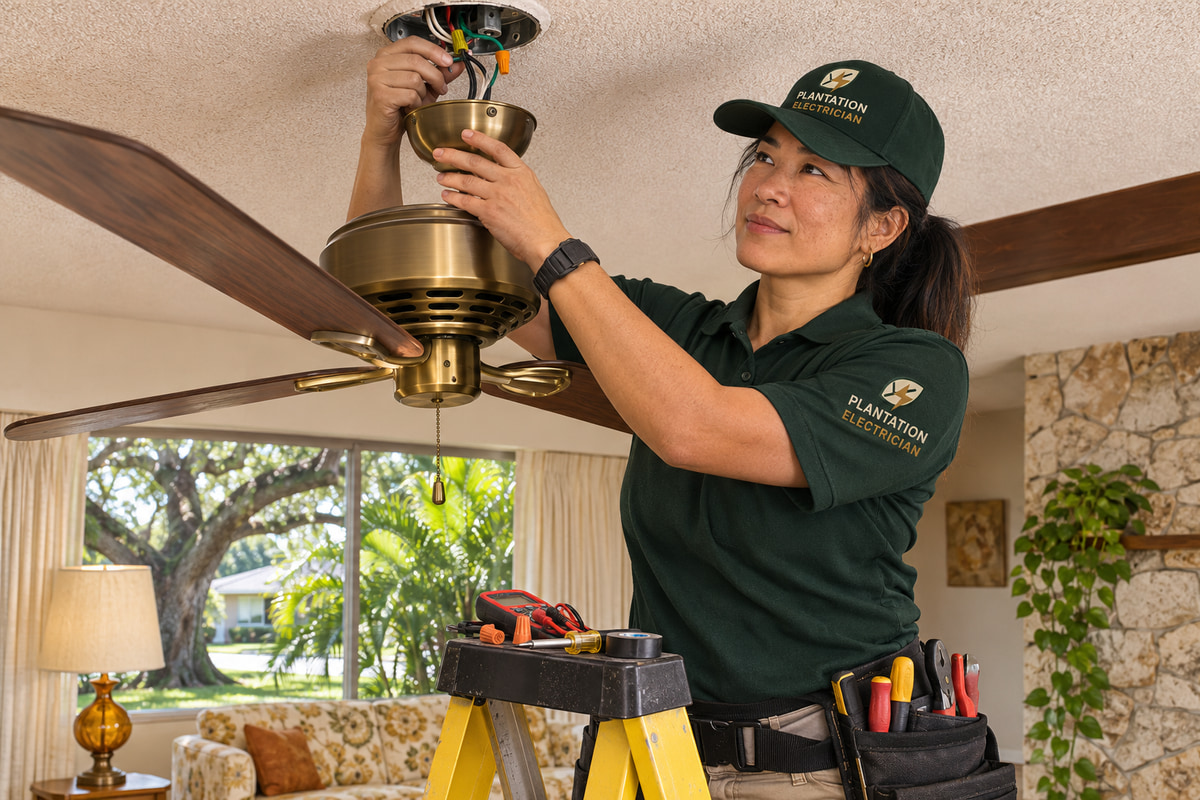
Long established streets and the houses that line them
Heritage Park is on South Fig Tree Lane, and the Plantation Historical Museum is located there. The area around it has long established residential streets, which makes it one of the older parts of the city to work in. Older does not simply mean worn. It means the house has a history, and an electrician walking in is, in a sense, reading that history in the wiring.
Older neighborhoods have texture. Lot sizes vary, houses were not all built at once, and owners over the decades made their own changes: an added room, a converted garage, a screened porch, a new kitchen. Each change tapped into the existing wiring somewhere. A house that looks like one coherent building from the street may actually be an assembly of several electrical eras. The original part has one style of wiring and a certain age of devices. The first addition has another. The most recent remodel has another still. Where these meet, in junction boxes in the attic or splices in a wall, is where surprises hide.
The goal of electrical work here is usually twofold. First, make the house safe and reliable for the way people live now. Second, do that without unnecessarily damaging the parts of the house that give it character. Plaster or textured walls, original trim, mature landscaping and old windows are often the reason someone bought the house. Good electrical planning respects those, using attic and crawl routes where possible, surface raceways where walls should not be opened, and careful repair of any openings that are needed.
This page is a guide to the kinds of issues owners of older homes should be aware of. It is written in general terms. It does not describe particular houses or claim details about specific streets beyond what is commonly known: that the area is established and residential, and that it holds the park and the museum. Your own house will have its own story, and the best way to learn it is to have someone look.
If you are new to an older house, one of the best early investments is a thorough electrical review before major projects. It tells you what you have, what is urgent, and what can wait. It also gives you a baseline, so that when you plan a kitchen remodel or a new air conditioner, you know what the electrical system can carry and where it will need help.
Original wiring, what it is and which questions to ask
Original wiring in a long established home can vary a great deal with the age of the house, so it helps to know the main possibilities without assuming any one applies to you.
In the oldest houses, you may find wiring that predates grounded systems entirely, with two conductor cable and outlets that accept only two prongs. Some of this cable has a fabric or rubber based insulation that dries and cracks over time. In slightly later houses, you find plastic sheathed cable, which is more durable, still with no ground wire in the earliest versions. Over the decades after that, grounded cable became standard. A single house can easily contain several of these types.
The questions worth asking are straightforward. What type of wiring runs through the house? Is it in good condition where it can be inspected, such as in the attic and at the panel? Are the connections secure and the boxes intact? Are there any abandoned or spliced sections? Is the grounding system for the house intact, meaning a grounding electrode and a bond to the water pipe or other required elements? Are the devices in good shape?
Another important question concerns past modifications. Previous owners may have added circuits with the help of friends or professionals of varying skill. Tell tale signs include mismatched cable types, junction boxes without covers, wires twisted together and wrapped with tape, and circuits that do not match the panel labels. It is not unusual to find a light switch that controls an outlet nobody expected, or a breaker that turns off power in rooms on opposite sides of the house.
Some owners worry that the only answer to old wiring is a full rewire. That is sometimes the case, but not always. Often, a careful combination of targeted repairs works well: replacing the panel, correcting problem circuits, installing protective devices, replacing deteriorated devices, and rewiring only the areas where cable is failing. The right amount of work depends on what is found.
For some houses, a full or room by room rewiring is the best long term solution, especially where cable insulation is brittle throughout. When that is the case, it is often done in stages, finishing one part of the house at a time so that the family can remain in residence. A staged approach also lets the owner coordinate electrical work with other projects such as painting, flooring, or kitchen changes. The preparation and patching that follow are worth planning for in advance.
In every case, ask for the findings to be explained in plain words and, where possible, shown to you. Photographs of what is inside a panel or above a ceiling make it easy to understand the reasoning behind a recommendation.
A worked example from a house with several additions shows why tracing matters. Imagine a home where a rear room was added long ago and the switch by its door controls a lamp outlet in the old living room. The family finds that when they plug a space heater into the rear room, a breaker trips and the hallway light dims. Tracing reveals that the rear room was tapped from a hallway junction box that also feeds the original bedrooms, so one cable now carries more than it was meant to. The remedy is not a bigger breaker. It is a new circuit for the addition, run through the attic to the panel, with the old tap removed and the junction box covered and labeled. The tracing took time, but it turned a mystery into a clear fix, and that is the best argument for a careful first visit to any house with a layered history.
Updating without erasing what makes the house special
Many owners of older houses care about their character and want electrical improvements that do not announce themselves. There are several ways to do that.
Use the attic and the spaces above and below. Most additions can be routed through attics, where cables can be pulled across and dropped into walls through existing paths. Where a floor is a slab, running cable from above is typically the only option.
Fish cable rather than cut. Electricians have tools for pulling cable through finished walls with small access holes that are easy to patch. In plaster walls, the approach needs extra care, since plaster cracks easily; sometimes a better choice is a surface raceway painted to match the wall, which keeps the original surface intact.
Match devices to the house. Switch and outlet plates come in a wide range of styles. Choosing a finish that suits the age of the house is a small, effective way to preserve its feel. Dimmer switches for original fixtures can bring older chandeliers and wall sconces back to life, provided the fixtures themselves are safe. Rewiring a vintage fixture, replacing cracked sockets and frayed cord, is often possible and worth doing.
Hide the new within the old. A charging outlet can live inside a cabinet. A new circuit for a kitchen appliance can follow existing chases. Lighting upgrades can use fixtures that are visually quiet.
Add what is needed, no more. Not every room needs recessed lights, and not every outdoor space needs a floodlight. Respect the proportions of the house.
Some updates are not optional, whatever the style. Panels should be sound. Protection devices should be installed in kitchens, baths, garages and outdoors. Smoke alarms should be working. Aging wiring in poor condition should be replaced. Safety and character are not in conflict; with planning, you can have both.
If your house is old enough that questions of historic character apply to a project, check with the relevant authority before changing exteriors or visible features. Many homes in established neighborhoods are not subject to special rules, but it is worth confirming for your own address, since exterior fixtures, service masts and meter locations are visible from the street.
Finally, think about what happens behind the walls when you renovate. Renovation tends to uncover old wiring that must be brought up to current practice when it is extended or altered. Allowing for that in the budget and schedule prevents surprises. A good electrician will tell you early, during the walkthrough, what is likely to be found and how it would change the plan.
Trees, roots and the line that brings power to the house
Trees are part of the appeal of established streets, and in this area they are often decades old. They shade houses, cool yards, and sometimes grow right up against power lines and service equipment. The relationship between old trees and electrical systems is worth understanding, because it is the source of many avoidable problems.
At the top of the list is the service drop, the cable that runs from a utility pole to the house on overhead services. Branches that rub against it wear the insulation over time, and in a storm a heavy limb can pull the cable loose or tear the mast away from the house. Only the utility is authorized to work on its own lines and the connection at the pole, and tree work near energized lines should be done by those qualified to do it. If you see branches touching the line, contact the utility. On the house side, the mast, weatherhead and meter base belong to the homeowner, and they should be sound and securely fastened. A mast that leans or a meter base that has pulled away from the wall needs prompt repair.
Roots come next. In older yards, there may be buried conduit or direct burial cable to detached garages, sheds, pool equipment, and landscape lighting. Roots can crush or pull on these lines, and a cable damaged by roots can leak current into the ground, a ground fault that may not be obvious until it trips a protective device or causes tingling. Before any digging, have the buried lines located.
Falling leaves and debris also matter. They clog gutters and funnel water onto the meter and service equipment. Keeping gutters and roof lines clear near the service helps, and so does cleaning around outdoor receptacles and fixtures.
Storm season brings the worst of it. A large limb can land on a roof, a line, or a mast, and the consequences range from a minor outage to a serious hazard. After a storm, avoid any wires on the ground or hanging low, and treat them as live. Do not touch fallen trees that are in contact with wires. Call the utility and emergency services if needed.
Preventive steps help. Have trees trimmed by professionals on a regular schedule. Consider whole house surge protection, which reduces the damage from line disturbances. Make sure the house grounding is intact. For households that depend on electricity for medical equipment or work, consider a backup power plan with a properly installed transfer arrangement.
An electrician visiting an older house under large trees will usually take a walk outside first, looking up at the service and down at the ground. That outdoor look often reveals as much as the panel inspection does.
Safety layers that older rooms often lack
Older homes are often missing the layers of protection that newer construction takes for granted. Adding them is among the most valuable things you can do, and most can be added without major disruption.
Ground fault protection. Kitchens, bathrooms, garages, laundry areas and outdoor outlets should have it. In older houses, this can be done at the receptacle or at the breaker, even where there is no ground wire.
Arc fault protection. Bedrooms and living areas gain meaningful fire protection from arc fault breakers, particularly where cable is old or has been disturbed. Availability depends on the panel.
Smoke and carbon monoxide alarms. These save lives. Interconnected units that sound throughout the house when one detects a problem are ideal. Place them according to the manufacturer's directions and local requirements, and test them monthly. Replace them at the recommended interval, since sensors wear out.
Surge protection. Whole house surge protection at the panel, combined with point of use protectors for sensitive equipment, is a sensible measure in a region with frequent lightning.
Proper grounding and bonding. The grounding system gives fault current and surges a safe path. In older homes, it may be incomplete, corroded, or disconnected. Checking it is a quick and valuable step.
Adequate capacity. A panel with room to add circuits means less temptation to overload existing ones. Where a house has only a few circuits, adding some can transform how safe and convenient the house is.
Labeled panels. A clear panel directory is itself a safety feature, because in an emergency you must know which breaker to turn off.
Not every old room needs all of these at once. Prioritize by risk. A kitchen with a single circuit for all counter outlets and no ground fault protection is a high priority. A seldom used guest room with sound wiring is lower. Walk through your house and ask where water, heat and cords gather, and where people sleep. Those are the places where protection counts most.
Remember that protection devices do not fix underlying problems. If a ground fault device trips repeatedly, find out why. If an arc fault breaker trips, investigate. They are alarms that tell you something is wrong, and the correct response is to find the cause.
How a first visit to an older home usually goes
If you own an older home near Heritage Park and are considering electrical work, it helps to know what to expect from a first visit.
You begin with a phone call where you describe the house: its approximate age, what has been updated, and what is bothering you. A quote does not come over the phone for anything beyond the simplest tasks, because older houses hold surprises, and any job involving a panel, rewiring or new circuits requires seeing the house.
At the visit, the electrician starts by listening. What do you notice? Which rooms? Since when? Then comes a walk through the house, including attic access if it exists, the garage, the exterior service, and the panel. A tester is used on outlets to check wiring and ground. The electrician may open a few devices to see the wiring behind them, and may take photographs.
After the inspection, you get an explanation. A good one separates what is urgent from what is advisable from what is optional. It names what was found in plain words and avoids pressure. You should leave knowing the options, including the approximate sequence of work and what would make it simpler or more complicated.
If work goes ahead, expect planning for access: moving furniture, protecting floors, deciding where openings will be made and how they will be patched. For a house with plaster, discuss expectations for patching openly in advance. If power must be off for part of the day, plan for refrigeration, medical needs and work from home.
When the job is complete, the work should be tested and explained. Protective devices are shown to you and tested. The panel is labeled. Any permit and inspection steps that apply are handled, and you receive documentation. If something unexpected was found during the work, you should be told clearly.
Afterward, keep a simple record. Take a photo of the labeled panel, keep your paperwork, and write a few lines about what was done. In a house that may change hands in the future, this record is helpful.
And finally, give the house time. After new devices are installed, watch for any unusual behavior: tripping, buzzing, warmth. Report it promptly. A good electrician wants to hear about it and will want to resolve it.
Common requests from older homes here
The calls from this part of Plantation often fall into a handful of groups.
- Panel replacement. Swapping out aging panels and fuse boxes for equipment that suits today's loads.
- Targeted rewiring. Replacing failing cable in particular rooms or sections of the house.
- Grounding and protection. Bringing two slot outlets and unprotected circuits up to a safer standard.
- Service mast and meter base repair. Fixing leaning masts, loose bases and damaged weatherheads.
- Vintage fixture repair. Rewiring older lights so they can be used safely.
- Charger and air conditioner circuits. Adding capacity for modern loads in older houses.
Nearby areas
Heritage Park lies along Fig Tree Lane, which has its own page here, and the Peters Road area is just to the west with its ranch style homes. The Cleary Boulevard neighborhoods are also close by. Each has slightly different housing, so pick the page that best matches your street.