

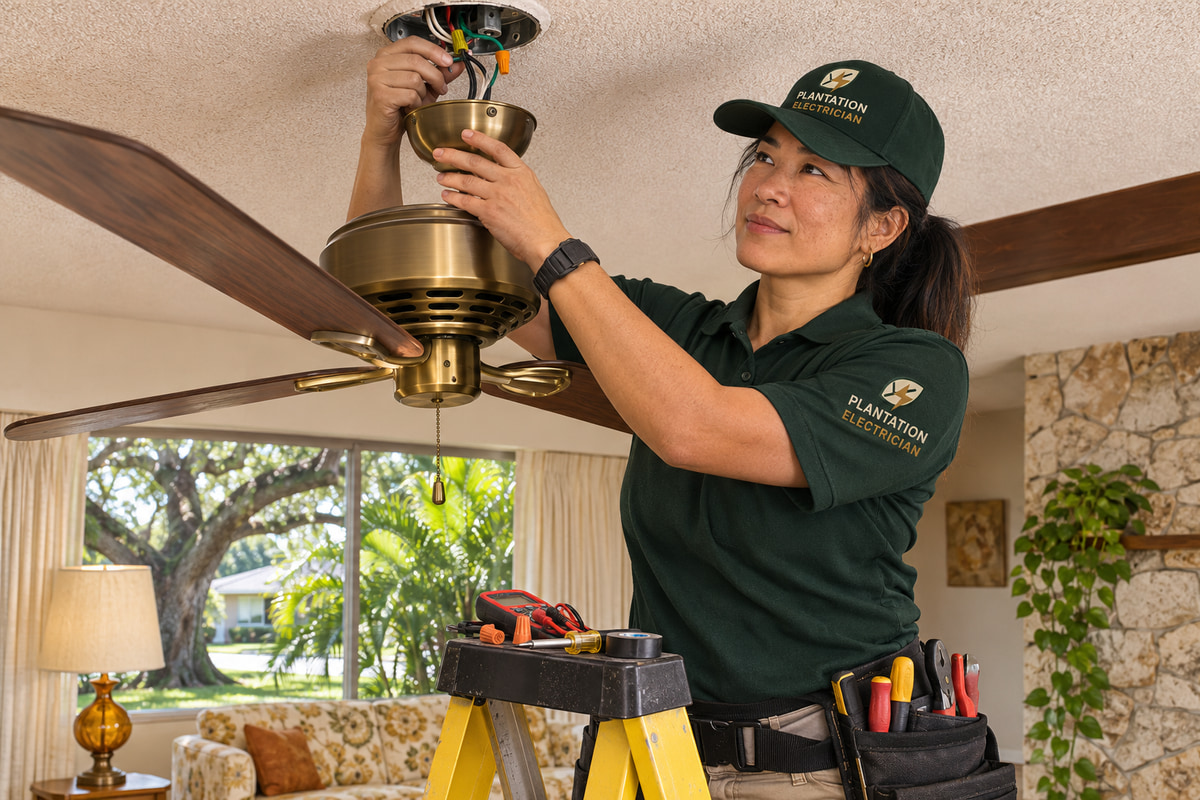
Reading the street pattern along Cleary Boulevard
Cleary Boulevard is an east and west road in Plantation, and like most through roads in an established suburb it acts as a spine. Quieter residential streets branch off it, and the houses on those streets were built over a stretch of years instead of all at once. That is the first thing worth understanding before anyone talks about wiring. A neighborhood that filled in gradually is a neighborhood where the houses, though they look alike from the curb, may contain different generations of electrical thinking.
Walk a few blocks near the boulevard and you will notice the features that define this part of town. The streets are lined with mature trees. Lots are comfortable, with room for a carport or garage, a back yard and often a screened porch or pool. Many homes are single story, which in South Florida usually means concrete block construction with a roof that carries the air handler or has an attic above the ceiling. These details matter to an electrician because they decide where wires can run, how hard it is to reach them and what has changed since the house was first built.
The housing here is old enough to have seen several rounds of renovation and young enough that most of it is still in service in its original shape. That combination is common and, honestly, fairly comfortable for owners. Nothing about a home from this era is alarming by default. It simply means that the electrical system was designed for the way people lived then, with fewer devices, smaller appliances and less demand on each room. The work that follows from that is mostly about catching up, not about fixing something broken.
When someone calls from a street near Cleary Boulevard, a useful first question is how long they have lived in the house and what has been done to it. A long term owner can usually say when the roof was replaced, when the air conditioning was last changed and whether a kitchen or bath was remodeled. Each of those events touched the electrical system, sometimes properly and sometimes only enough to get by. A recent buyer may know little, which is also fine, because the first conversation can simply map out what is there.
Nothing on this page is meant to describe a particular address. Instead it describes the usual conditions of homes of this type and period, and lists the questions worth asking about your own house. An on site visit is how those general ideas turn into a real answer for your walls, your panel and your yard.
What a house from the 1960s to the 1980s tends to carry
The neighborhoods near Cleary Boulevard date largely from the 1960s to the 1980s, and those decades cover a surprising range of electrical practice. A house from the early 1960s and a house from the late 1980s can sit on the same street and still differ in wire type, panel brand, outlet style and how many circuits they were given.
Here is a rough way to think about the eras, kept general on purpose:
- Early to mid 1960s. Panels were modest in size, often with fewer circuit spaces than a family uses today. Many outlets in a room were fed from a single circuit, and two prong receptacles may still exist in spots that were never updated.
- Late 1960s and 1970s. Air conditioning became standard, so these homes often have a large cooling load that was added to a panel never planned for it. Some homes from the period used wiring materials that later drew attention, and a careful look inside the panel and at outlet connections is the sensible way to find out what a given house contains.
- 1980s. Grounded outlets became the norm, kitchens gained more dedicated circuits and panels grew. These houses are often in better shape, though components such as breakers and switches are now decades old.
Age alone does not tell you the condition. A house with original wiring that has been kept dry and unmodified can be in better shape than a younger house where several do it yourself projects were done with the wrong parts. What counts is what the electrician sees: the color and flexibility of the wire insulation, the tightness of connections, signs of heat at outlets and the tidiness of the panel.
One of the more common discoveries in houses of this age is a mix of old and new work. A bathroom may have a modern ground fault outlet while the garage still has a plain one. The kitchen counter may have updated receptacles while the wall behind the refrigerator still holds an original outlet that has loosened over the years. This patchwork is normal, and a good plan simply lists what is protected and what is not, then orders the work so the most useful safety items come first.
It is also worth remembering that the codes in force when a house was built were suitable for that time. Owners are not expected to rebuild everything to the current standard. But when significant work is done, such as a panel change or a remodel, the new work generally follows current rules, and the city permit office can explain what applies to a specific project.
Consider a worked example. A family buys a single story block house on a shaded street near the boulevard. During the first month they notice that the bedroom outlets feel loose, the hallway light flickers when the air conditioner starts, and the garage outlet trips whenever the freezer and a saw run together. None of these needs a rewrite of the house. The loose outlets are replaced, the flicker is traced to a connection at the panel that is tightened and tested, and the garage gets a second circuit so the freezer has its own line. The whole story is three small, sensible repairs that a patient visit uncovered, and a short written list gives the family a plan for anything bigger later.
Panels and circuits that have run out of room
If one electrical problem shows up again and again in homes of this age, it is simply running out of capacity. A panel that felt generous in 1970 can feel cramped today, because the household has added a bigger air conditioner, a second refrigerator, a home office, a clothes dryer that gets used daily, perhaps a pool pump, and an increasing number of chargers and gadgets. None of those were in the original plan.
The signs of a stretched system are easy to spot once you know them:
- Breakers that trip when two ordinary appliances run together.
- Lights that dim for a moment when the air conditioner starts.
- Extension cords and power strips used as permanent wiring.
- Panel spaces that have been doubled up with tandem breakers to squeeze in one more circuit.
- Handwritten labels that no longer match what the breakers control.
Each of these is a message, not a crisis. A tripping breaker, for instance, is doing its job by stopping the circuit before wires overheat. The question is why it trips: too much load on that circuit, a loose connection, a failing appliance or a worn breaker. Testing tells these apart, and replacing the breaker without understanding the cause is rarely the right move.
When capacity is the real issue, there are usually a few paths. Sometimes the answer is rearranging loads, giving a heavy appliance its own circuit and relieving a crowded one. Sometimes it is adding a small subpanel to create room. And sometimes it is replacing the main panel with a larger one, which may also involve the service equipment and a permit. Which path suits a house depends on how much power the home needs, how the current service is built, and what the owner plans to add. A load calculation, done by walking through the house and listing the equipment, is the honest way to decide.
Owners sometimes ask whether a panel upgrade is needed before an insurance renewal or a sale. Practices differ between insurers and buyers, so the best step is to ask them what they require, and then have an electrician look at the panel and document its condition. We do not quote from a distance for this kind of work. A quote for simple items can start by phone, and a panel conversation needs a visit.
Finally, think about the future before the work, not after. If an electric vehicle, a generator or a new addition is likely within a few years, say so during the visit. It is much cheaper to size a panel once for the next decade than to open it up twice.
Mature trees, roots, rain and the wiring outside the walls
Tree lined streets are one of the best things about this part of Plantation, and they are worth a few paragraphs because they influence electrical work in ways residents do not always connect. The shade lowers cooling costs and makes yards pleasant. The same trees, though, grow roots, drop limbs and push against anything buried or hung nearby.
Consider the service to the house. Depending on the property, power may arrive overhead through a service drop to a mast on the roof or wall, or underground to a meter. If it comes in overhead, tree branches rubbing the line or the mast are a concern that belongs to the utility up to the point of attachment. Past that point, the mast, the weatherhead and the meter base belong to the homeowner, and those parts are worth a look when they show rust, loosening or a lean. A mast that tilts after a storm should be addressed promptly.
Buried wiring is another matter. Many yards have underground cable running to a detached shed, a pool pump, a gate or landscape lighting. Roots can squeeze conduit over many years, and old direct burial cable can crack if it was laid shallow or without protection. The first sign is often a ground fault device that trips on a damp morning, or lights that work only after dry weather. Because water is the usual culprit in this climate, moisture inside a junction box or fixture is where an electrician starts looking.
Outdoor fixtures face the same weather. Light fixtures on a wall under a tree keep damp, and gaskets harden with age. Corroded sockets, discolored lenses and tripping outdoor outlets are cues to inspect. Fittings made for wet locations, and covers that close over a plugged in cord, are the sensible choices for this climate.
A few practical habits help:
- Trim branches away from service lines through the utility or a qualified professional, never by reaching toward a wire yourself.
- Keep a note of where underground lines run before anyone digs for a fence, a tree or a patio.
- Test outdoor ground fault outlets monthly and after heavy rain.
- Treat any line on the ground, sagging or sparking as dangerous and call the utility, staying well back.
Trees also drop debris into gutters and onto roofs, which brings us to attic wiring: when a roof leaks, water often finds the wires in the attic first. A stain on a ceiling near a light fixture deserves attention, because the combination of moisture and electricity is one to take seriously.
Kitchens, baths, garages and the rooms that work hardest
Not every room in an older house asks the same of its wiring. The kitchen, the bathrooms, the laundry and the garage carry the heaviest and wettest loads, and they are where updates give the most benefit in homes from the Cleary Boulevard era.
In the kitchen, think about how the room is used now. Houses of this period were often wired for a smaller range of appliances, so the counter outlets may be few and share a circuit with lights or the dining room. Today a coffee maker, toaster, blender, air fryer and microwave may all want power within a few feet of one another. Dedicated small appliance circuits, ground fault protection near the sink and a separate circuit for the refrigerator are common goals of a kitchen update. When a kitchen is being remodeled, the electrical layout should be decided with the cabinet plan, so outlets land where they will be used and not behind a cabinet door.
Bathrooms need ground fault protection at the outlets, a fan that actually moves air and fixtures rated for the damp. A bathroom fan that has run for decades may have a motor that draws more current as it wears, and lights that flicker or hum can point to a loose connection or a failing dimmer. In a house with one original bathroom and one added later, the two rooms often follow different standards, and it is worth comparing them.
The laundry area, often tucked into a garage or a corner of the house, usually holds a dryer outlet and a washer receptacle. A dryer outlet that feels warm, discolors or smells hot when in use is a concern, since it handles a large current for long stretches and cord connections loosen with vibration. A worn dryer receptacle is an inexpensive part but an important one.
Garages in these neighborhoods frequently serve as workshops, storage and sometimes a second living space. Outlets there are commonly too few. Workbench tools, a chest freezer and an extra refrigerator all pull from the same circuit, and extension cords snake across the floor. Ground fault protection is especially useful where the floor may be damp. If the garage has been converted to living space, the wiring must be treated as living space wiring, which can mean an entire rework with permits.
For each of these rooms, a simple weekly look is enough to catch trouble: any outlet that is warm, loose or discolored, any switch that crackles, any fixture that flickers. These are not emergencies when caught early, and they make easy visit notes.
Planning the work, preparing for a visit and weathering storm season
Good electrical work in an established neighborhood comes from good planning, and planning begins with a conversation. A call to describe the house, its age and the problem is the start. A quote for simple items can be given by phone, and anything involving the panel, new circuits or several rooms needs someone to look at it in person. That is not a sales tactic. Wiring behind plaster and block cannot be judged from a description.
Before a visit, a little preparation saves time:
- Clear a path to the panel, indoors or in the garage, so it can be opened without moving boxes.
- Make a list of symptoms: which rooms, which times of day, which appliances were running.
- Note any past electrical work and who did it, if known.
- Gather recent photos if a problem is visual, such as a scorched outlet.
- Think about future plans so they can be included in the layout.
During the visit, expect questions. A careful electrician will ask what you have noticed, look at the panel, test outlets, check ground fault devices and peek at accessible wiring in the attic or garage. You will usually be shown what was found and why it matters, in plain words. Ask about the permit as well: for larger work the city permit office decides what is required, and an inspection after the work gives you and any later buyer a second set of eyes.
Storm season deserves a short mention because it is part of life here. Preparation that suits a home near Cleary Boulevard includes knowing where the main breaker is, keeping the panel dry and unobstructed, considering surge protection at the panel, and planning how a portable or standby generator would connect safely. A generator must never be plugged into a house outlet to feed the wiring, because that can send power back to the lines and endanger line workers. A transfer switch installed by a qualified electrician is the safe route.
After a storm, the routine is simple: stay clear of downed lines and standing water, do not use wet outlets or a wet panel until inspected, and bring appliances back online one at a time. Trees near homes in this area can drop limbs onto a mast or fixtures, so look at the roofline and meter once it is safe.
If something does not seem right, whether it is a smell, a buzz or a warm switch plate, treat it as worth a call. Most issues found early are modest repairs, and that is precisely the idea of paying attention.
Settings around Cleary Boulevard
Even within one stretch of road, the surroundings differ, and each brings its own electrical questions.
- Streets directly off the boulevard. Homes with easy access for service vehicles, where meter and mast condition are quick to check.
- Interior tree lined blocks. Quieter streets with mature canopy, where overhead lines and buried yard wiring deserve attention.
- Homes with pools and screened porches. Properties with outdoor circuits, pump equipment and wet location fixtures that need regular testing.
- Houses that have been renovated. Places where old and new wiring sit side by side and a labeled panel is especially useful.
Nearby areas and related reading
West Plantation toward the expressway has its own character, covered on our page about the western edge of the city. Tamarac to the north has large condo and villa communities, and our guide to outdoor and landscape lighting suits the tree lined yards described here. If you are getting ready for a visit, the page on preparing for an electrician walks through the steps.