

Inside the unit and outside it: where an owner responsibility usually ends
Before any electrical work in a condominium, the first question is who owns what. Generally an owner is responsible for the wiring and equipment inside the unit, starting at the unit panel and running out to every outlet, switch, fixture and appliance. The building supply, the meter equipment, the common hallways, the outside lighting and the shared utility closets usually belong to the association. Governing documents settle the details, so a quick read saves trouble later.
Sunrise Lakes is a community of condominium buildings in Sunrise, and as with most communities of this kind, the buildings share common systems that the association maintains. That is a convenience for an owner, because roofs, grounds and shared lighting are not your problem. It also means that some electrical symptoms may come from outside your door. A flicker that affects several neighbors at once is often a building question, not a unit question.
A useful habit is to check whether the problem is limited to your unit. If lights are out in your unit but the hallway is lit, the trouble is probably inside. If everything on your floor has gone dark, tell the management office. We are glad to look at your side, but we cannot work on shared equipment, and a call to the right person first saves a wasted visit for both of us. It also gets the right problem in front of the right people sooner.
The unit panel is the heart of what you own. It usually sits near the entry, in a closet or in the utility area, and it holds the breakers for the rooms and the large appliances. Keep the area in front of it clear so that the breaker handles can be reached quickly if something goes wrong. Please do not open the panel cover to investigate. Leave that to a qualified electrician.
When you plan any change, it helps to have documents in hand. Gather the association rules about contractors, any floor plan you might have and the age of the unit if you know it. If you are an owner who lives elsewhere and a relative or a property manager is handling the unit, let us know who will be on site. A little organization at the start often decides whether a job goes smoothly, and it spares you from hunting through drawers while an electrician waits.
What tends to wear in condo units that have been lived in for decades
Units in long established condominium communities tend to have electrical systems that were designed for a lighter household than most people have today. Many were built when a few lamps, one television and a modest kitchen were the norm. The wiring was fine for that time, and a good portion of it still works. But decades of use mean that outlets, switches and connections are due for attention in a way a newer unit would not be.
Outlets are a good example. A receptacle that has been used and moved many times can lose its grip on plugs, so that a lamp cord wobbles or a charger falls out. A loose plug generates heat at its contact points, and the heat slowly damages the outlet. Replacing worn receptacles is inexpensive in effort and often removes a nuisance and a risk together, as we describe on our page about outlet, switch and receptacle repair.
Some older buildings in Florida used aluminum for branch wiring during one period of construction, and that deserves a careful look when it is present, because aluminum behaves differently from copper at connections. We do not assume a unit has it, and we do not scare owners about it. If you see a mix of wire types in an inspection report or an insurer asks about it, a qualified electrician can check what is actually in the walls and explain the options.
Kitchens and bathrooms have changed more than any other rooms. Modern appliances such as dishwashers, microwaves, air fryers and induction cooktops ask more of the circuits than their predecessors did, and a kitchen that has been rearranged over the years may now have a tangle of extension cords in places where permanent outlets would be safer. Bathrooms, near water, should have ground fault protection that works, and it is worth testing it as the manufacturer recommends.
A careful inspection looks at all of this together. Our page on electrical safety inspections for existing homes describes what we look at in a typical visit, and a condo unit is no different in principle. We check the panel, test a sample of outlets, look at switches and fixtures and listen to what you have noticed. Then we explain what is urgent, what can wait and what is simply worth knowing.
Working inside a building with neighbors, elevators and quiet hours
Condominium living adds a layer of logistics to any repair. Buildings often have rules about the hours when contractors may work, about the use of elevators and loading areas, about where vehicles may park and about how debris is carried out. Some require a certificate from the contractor, a notice to the office or a deposit for larger projects. These rules exist to protect neighbors, and following them is part of doing the job well.
Because we are a Plantation based company serving Sunrise, we ask early about those rules instead of discovering them at the door. If your building has a front desk or a gate, tell us who to announce ourselves to. If your association needs a form filled out, bring it, and we will complete our part. Nothing makes a repair feel worse than a surprise at the entrance, and a few minutes of planning avoid it.
Approvals matter most when a project touches anything beyond the unit walls. Changing a fixture on a balcony, adding an outdoor outlet or altering a feed that runs through a shared chase may need the association to agree before work begins. Work inside the unit, such as replacing outlets or adding a circuit from the unit panel, is usually simpler, but the rules still apply to how and when the work is done.
The city comes into the picture as well. Electrical work generally involves a permit and an inspection through the local building department, and for Sunrise Lakes that means the city of Sunrise. The rules vary with the type of work, so we do not guess. Our page on what permit and inspection mean for your project explains the general idea, and every job should be confirmed on site.
Noise and dust are neighbor issues too. Drilling through a wall or cutting into a ceiling can carry sound through a building, so we plan loud steps for reasonable hours and protect floors and furniture. If a neighbor below you has a sensitive situation, such as someone who works nights or a person who is ill, tell us, and we will try to arrange the work so that it intrudes as little as it can.
Lighting, switches and outlets that make a home easier to live in
Many residents of an established community like this have lived there a long time and may be thinking about how to keep the home comfortable and safe for the years ahead. Electrical details make a surprising difference. A hallway that is bright at night, a switch that can be found without fumbling and an outlet at a height that does not require bending can all make an ordinary day easier, and none of them are large projects. They are the kind of changes a household notices every single day, long after the work is done and forgotten.
Lighting is the first thing most people notice. Older units often have dim fixtures or lights controlled from a single switch at the far end of a room. Adding a second switch at the other doorway, replacing a dim fixture with an efficient one or placing a small light near the bathroom for nighttime trips are all modest changes. Our page on aging in place electrical planning looks at these ideas in more depth.
Switches themselves can be improved. Large, easy to press rocker switches replace small toggles, and some owners prefer illuminated switches that glow faintly in the dark. Motion sensing controls can turn on a bathroom light without any touch. These devices are readily available and simple to install when the wiring behind the wall supports them, and a short look at the existing boxes tells us what is possible.
Smoke alarms are part of every safe home. They should be in the right places, working, and not past the age the manufacturer recommends for replacement. In a condominium the building may have its own alarm system in addition to the ones in your unit, and the two work together. Our page on smoke alarm placement and testing explains what to look for, and testing monthly is a habit worth keeping.
A last point is cords. Extension cords snaking across a floor are a trip hazard as well as an electrical one, and they tend to appear when there are not enough outlets in the right places. Adding outlets where you actually use them, such as beside a favorite chair or near the bed, removes the need for cords across walkways. It is a small improvement with a real benefit for safety and for peace of mind, and it usually takes far less work than people expect once a sensible location is chosen.
Power outages, surges and being ready when a storm comes through
Hurricane season matters to everyone in Broward County, and condo residents have their own set of concerns. Elevators may stop during an outage, air conditioning goes off and refrigerators warm up. For someone who relies on medical equipment that needs power, an outage can be more than an inconvenience. The time to plan for it is well before the season, not while the lights are flickering and the radio is on.
If a person in your household depends on electrical medical equipment, talk to the equipment supplier and to the doctor about backup plans, and let the local utility know through its own program. We cannot give medical advice, and we do not claim to solve this with wiring. What we can do is help you understand how power reaches the unit and what kinds of backup are realistic in a building with shared rules.
In many condominium buildings, a generator hookup for an individual unit is not practical, and common area generators belong to the association. Smaller portable power stations that run quietly indoors may serve a few devices, and they do not produce exhaust the way a fuel generator does. Never run a gasoline generator inside a unit, on a balcony or near a window. Carbon monoxide is invisible and deadly.
Surges are a quieter problem. Storms and utility switching can send brief spikes into a unit, and the electronics inside cope with them for only so long. Good quality protectors at the outlets that serve your television, computer and other valuable devices are a sensible layer. Ask us whether protection at the unit panel is possible in your building, since the answer depends on how the panel is arranged and what the association permits.
After a storm, be careful. If water has entered the unit, stay away from outlets and the panel, and do not turn anything on until a qualified electrician has checked it. If you smell burning, see smoke or hear crackling, call 911 first and leave the unit. Report outages and hazards in common areas to the management office, and if a neighbor needs help and you can give it safely, check in on them.
New appliances, old circuits and getting the match right
A common reason for a call from a condo owner is a new appliance that does not fit the old circuit. A bigger microwave, a new dishwasher, a washer and dryer pair or a change from a gas to an electric stove each asks something of the wiring. If the circuit is too small, the breaker will trip often, and if the breaker has been changed to a larger size without changing the wire, the situation is dangerous. Checking before the delivery date is far better than after.
Window and wall air conditioners are another popular question. Some units are plug in and can share a normal circuit, while larger ones need dedicated wiring. Running one on an extension cord is a fire risk, and plugging several into the same outlet is asking for trouble. If a unit trips the breaker each time the compressor starts, the cause may be the circuit, the outlet or the equipment, and it should be traced, not forced.
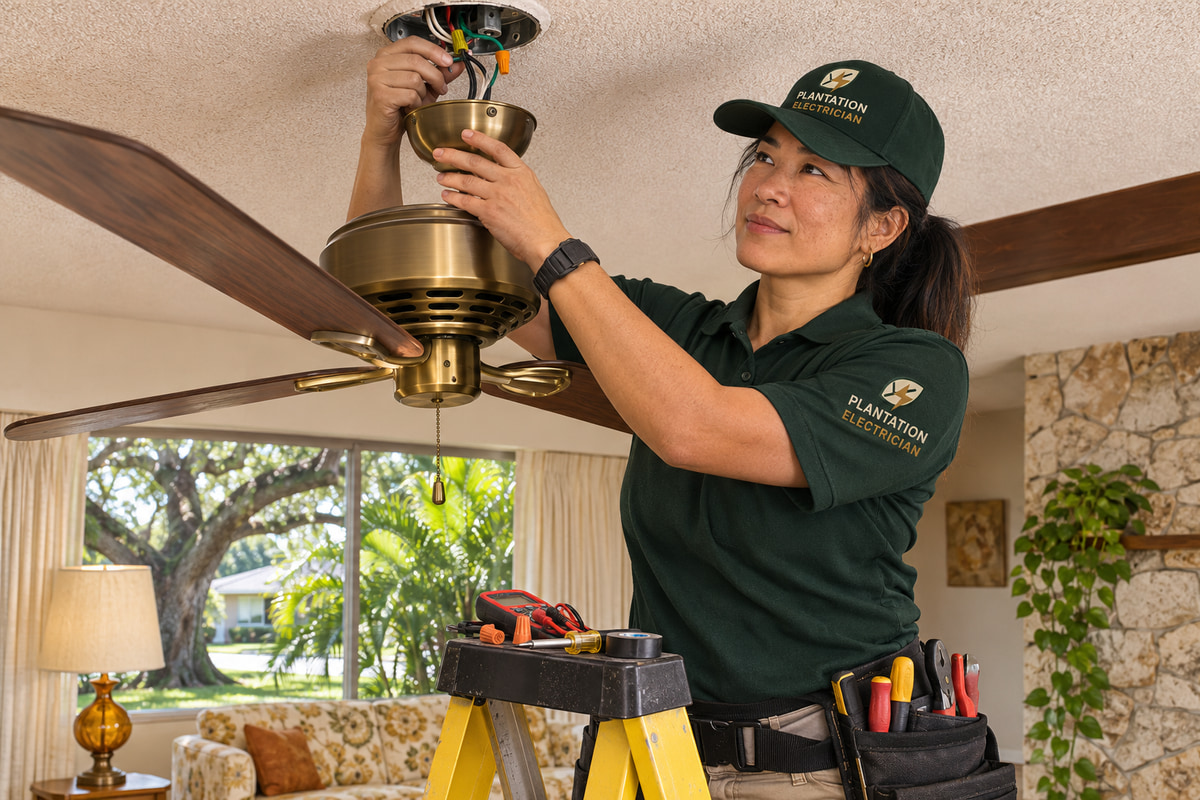
Ceiling fans can make a unit feel better at lower cooling cost, and a fan with a light and a remote is an easy upgrade where the box is suited to carry the weight. Fan boxes are built differently from ordinary light boxes, because a fan pulls and shakes as it spins. We check what is above the ceiling and use a proper fan rated box so that the fan does not loosen over time.
Bathrooms deserve special care. Ground fault protection should be present near sinks and showers, and exhaust fans should be wired to a switch and vented in a way that the building allows. Heated mirrors, night lights and small heaters are conveniences that add to the load of a bathroom circuit, so it is worth checking before adding them. Similar projects come up for condo and villa owners in nearby Tamarac, a little farther north.
When you are not sure whether an appliance will work with your circuits, bring us the model number or a photo of the nameplate before you buy. A few minutes with a tape measure and a look at the panel can save a return trip to the store. We will tell you what the circuit can handle and what, if anything, needs to change, and we will explain it in plain words with no pressure.
How we approach a call from a Sunrise Lakes owner
When someone calls about a condo unit, we begin by listening. What happened, when did it start and what changed in the home around that time? A new appliance, a storm or a recent renovation next door can all point to a cause. We ask about the building, the floor and any rules about contractors, and we decide together whether a visit is needed or whether a few questions and a simple answer will do.
If a visit is needed, we plan it around you. Many owners appreciate an unhurried conversation, a clear explanation and an electrician who does not rush out the door. We bring the questions and the answers in plain words, we show you what we find, and we write it down so that you can share it with family or the association if you wish.
Family members often help with these decisions, sometimes from far away. If a daughter in another state is making arrangements for a parent, we are happy to talk with her and to explain what we find in terms she can pass along. We will not do anything beyond what the owner agrees to, and we encourage owners to involve someone they trust when a project is larger than a simple repair.
Safety matters most. If you notice smoke, sparks, a burning smell or water around electrical equipment, call 911 first. If an outlet or a switch is hot, buzzing or discolored, stop using it, switch off the circuit if you can safely reach the panel, and call a qualified electrician. If something is urgent but not an emergency, our page on emergency electrical repair explains how we handle it.
Sunrise Lakes is close enough to our Plantation base that it fits comfortably within our service area, and we are glad to work with owners who have lived in their homes for a long time. If you are ready to talk, tell us what you have noticed and what you would like to change, and we will work out the next step with you, one clear conversation at a time.