

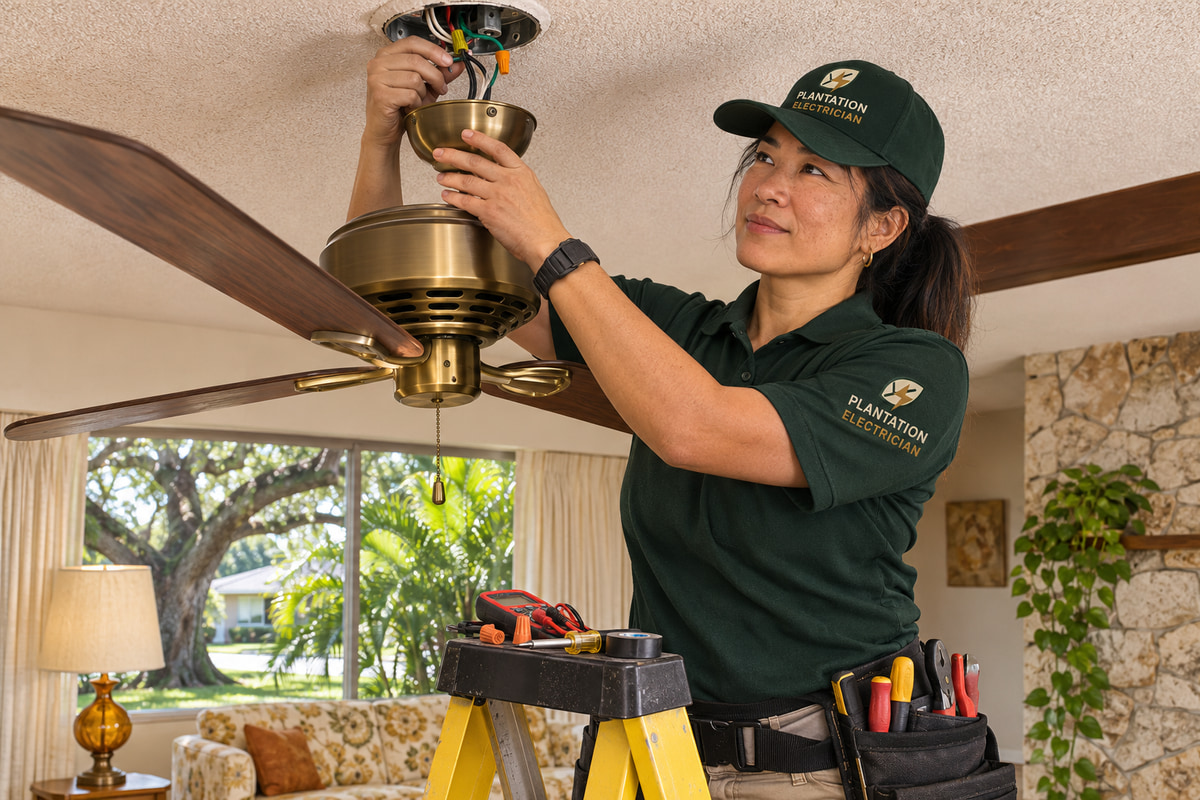
The ranch house and the way it was wired
Peters Road is an east west road in Plantation, and ranch style homes are common nearby. Heritage Park is nearby to the east. The ranch house, with its single story layout, low roofline and long footprint, is one of the most familiar housing types in South Florida, and its electrical system has recognizable features.
A single story house spreads its rooms across one level, so wiring runs horizontally, mostly through the attic, and drops into walls to reach outlets and switches. There is no second floor to route cable through and no basement below. The slab sits directly on the ground, so everything electrical lives in the walls and the attic. That arrangement has pros and cons. The pro is that attic access gives an electrician a way to reach most circuits without opening finished walls. The con is that the attic in a Florida house is hot, often cramped, and filled with insulation, ducts and, at times, uninvited wildlife.
The panel in a ranch house is commonly in the garage or on an exterior wall, sometimes in a hall closet. Circuits fan out from it to the attic and then across the house. Kitchen circuits, bathroom circuits, bedroom circuits and the air conditioning circuit each follow their own path. In an older ranch, the number of circuits is modest, and rooms often share them.
Over decades, owners modify. A carport becomes a Florida room. A garage becomes a family room or an office. A small bedroom becomes a bathroom. Each of these changes pulls new wires from somewhere. The best additions create new circuits from the panel. The worst tap into existing ones, adding load to circuits that were not designed for it, and extending cable in ways that are hard to follow.
The wiring itself in homes of this type is typically copper, with insulation that depends on the decade. Early cable may have cloth or rubber sheathing. Later cable has plastic sheathing. Aluminum branch wiring appeared in some homes from a particular period and requires special attention at connections. A house that has had an electrical inspection or panel upgrade is more likely to have documented its wiring type. If you are unsure, ask.
Ranch homes tend to age gracefully, and many have sound electrical systems waiting for modest updates. The goal of this page is to help owners spot which updates matter, and to support a conversation with an electrician about priorities. It describes general conditions in houses of this type. It does not claim anything about particular homes or streets.
Attic wiring in a single story home, the unseen half of the system
In a ranch house, the attic is where most of the electrical story is told. Cable from the panel climbs into the attic and spreads across the house, connecting junction boxes, light fixtures and the cables that drop down to switches and outlets. When something fails, the cause is often up there.
Heat is the main enemy. A Florida attic in summer reaches temperatures that stress every material. Cable insulation dries and becomes brittle, particularly in older installations. Plastic fittings crack. Metal boxes rust where condensation forms. Splices made with tape rather than connectors dry out and loosen.
Cable can also be damaged by other activity in the attic. Air conditioning technicians crawl through. Insulation installers blow material over and around cable. Rodents chew. Roof leaks drip. Each of these can leave cable bent, buried, chewed or wet. A visit to the attic is the single most revealing step in assessing a ranch house's wiring.
What an electrician looks for in the attic includes the type of cable; the condition of insulation; the way cable is supported, since it should be secured and not draped over ductwork or insulation; the presence of junction boxes with covers; the condition of splices; and the layout of circuits. Recessed light fixtures are checked for their rating and for contact with insulation. Bathroom fan wiring and ducting are inspected, since an unvented fan can add moisture.
Common problems include open splices with no box, cable running across the top of ductwork where it can be pinched or cooked, abandoned cable left live at an old fixture location, and new cable run by various tradespeople without regard to a plan. Fixing them is often straightforward once found: add boxes and covers, secure cable, remove or terminate dead ends, and label.
Planning is important when entering an attic. Work is best done in the cooler parts of the day, with proper protection against heat and with attention to where it is safe to step. Stepping off a joist can put a foot through a ceiling.
Attic work is also a chance to improve the house. Adding a junction box with a blank cover plate near the panel run gives easy access for future circuits. Installing a pull string or empty conduit for later low voltage cable saves effort. Documenting circuits with a sketch gives the next person a roadmap.
If you ever go into your attic, be careful. Stay on the joists, bring a light, wear protection, and do not touch cable or boxes. If you find damaged cable or signs of rodents or leaks, leave it alone and call for an inspection. If it is very hot, avoid entering at all. A professional with the right gear will do a better job and be safer.
Garages, carports and added rooms
The most active parts of a ranch house are often the ones that were added or converted. Their electrical systems tend to deserve a second look.
Garages. The garage holds the panel in many homes, along with a freezer, a workbench, a washer and dryer, and tools. Garage outlets should be protected by ground fault devices. Lighting should be sufficient and fixtures suited to the space. Garage door openers need a convenient outlet, preferably not shared with a heavy load. A garage that now houses an electric vehicle charger needs a dedicated circuit and attention to capacity.
Carports. A carport may have a light, an outlet or two, and exposed wiring on a wall. Exposure to weather calls for weatherproof boxes, in use covers and protected circuits. Wiring running along a wall or post should be in conduit or an approved cable type. Because carports are open on the sides, they are exposed to splashing and humidity.
Florida rooms and enclosed porches. These spaces often began as screened porches. When they are enclosed, their wiring may be a patchwork: outlets added by tapping existing circuits, lights fed from the outdoor circuit, and air conditioning from window units. A room like this deserves a proper circuit scheme with a dedicated circuit for any added air conditioner and enough outlets to avoid cords.
Converted garages. When a garage becomes living space, wiring must meet the requirements for habitable rooms. That includes sufficient outlets, protected circuits, smoke alarms, and often the addition of air conditioning. Outdoor circuits and old garage door wiring may remain, creating confusion. A conversion is an excellent time to review and relabel circuits.
Added bedrooms and bathrooms. A bathroom added to a ranch house needs ground fault protection, a vent fan, adequate lighting and sometimes a dedicated circuit. Bedrooms need smoke alarms, and arc fault protection is appropriate in current practice. The permit process helps verify that the work complies with local rules.
Sheds and workshops. A detached shed or workshop in the backyard needs its own feed. A feeder from the main panel to a subpanel in the shed, with proper grounding, is the safe way. Extension cords from the house are not a long term solution.
Pools and patios. Many ranch homes have pools, and the equipment pad, lights and outlets require special care. Bonding and protection are critical.
With any addition, ask whether permits were pulled and whether the work was inspected. If you buy a house with additions, ask for documentation. Unpermitted work is not automatically unsafe, but it is unknown, and an electrician can assess it.
Small businesses around the road
Along and around Peters Road you also find small businesses, from offices and service shops to small retail. Their electrical needs resemble those of larger corridors on a smaller scale, and they have the advantage of being simple to plan if approached methodically.
A small business typically occupies a modest space with a single panel. The key questions are what equipment it runs, whether the circuits suit it, and how reliable the supply is. A small shop with a refrigerator, a few computers, a printer, a point of sale system and some lighting seldom stresses a panel. But add a compressor, a heater or a bank of chargers, and the margin shrinks.
Home based businesses and live work arrangements occur frequently in residential areas. A person running a studio from a converted garage or a back room needs dedicated circuits for equipment, enough outlets, and surge protection for computers and audio gear. They should also consider fire safety: smoke alarms, extinguishers, and unobstructed access to the panel.
A few specific small business situations come up often.
- Hair and beauty services. Dryers, irons, lights and a water heater. Ground fault protection near sinks, and multiple circuits to avoid overloading.
- Offices and consultants. Computers, printers and phones. Dedicated circuit for the network closet and a battery backup for important equipment.
- Repair and craft shops. Tools, benches, compressors and lighting. Dedicated circuits for heavy tools, and task lighting at benches.
- Small retail. Lighting, display cases, a register and signage. Outlets placed where displays will be.
- Food businesses. Refrigeration, cooking equipment and sinks. Ground fault protection and separate circuits for heavy equipment, plus attention to what the permit office requires.
In each of these, begin by listing equipment and noting the ratings. Next, check the panel for open spaces and for labels. Then ask whether the circuits make sense for the way the business runs. Overloaded or shared circuits are the usual culprits when breakers trip at busy hours.
Insurance and landlords may have requirements for electrical work. Ask your landlord what is allowed, and check whether permits are needed for the work. Keeping records helps.
For small businesses, downtime is expensive. Plan work for off hours when possible, protect refrigerated goods, and keep a plan for outages. A modest battery backup for the register and phone, and a surge protector for sensitive equipment, can keep a business operating through short interruptions.
Finally, treat small problems as signs. A flickering light over a counter, a warm outlet near a refrigerator, or a breaker that trips every afternoon are the small signs that lead to big failures. Addressing them early is nearly always cheaper than waiting.
Air conditioning, comfort and what the electric bill is telling you
In a ranch house in this climate, air conditioning is the electrical headline. It is the biggest load, it runs for most of the year, and its health shows up in comfort and in the bill. The electrical side of the system deserves attention along with the mechanical side.
The condenser outside and the air handler inside each have their own circuits, with breakers sized to the equipment nameplate. A disconnect near the condenser lets technicians shut it off safely. Over time, the disconnect, the whip of conduit and the wiring to the condenser are exposed to weather. Corrosion at the disconnect, loose lugs and cracked covers are all common. A condenser that trips its breaker repeatedly, hums without starting, or shuts off in the afternoon may have an electrical issue such as a failing capacitor or contactor, a loose connection or an undersized circuit. Capacitors and contactors are components that air conditioning technicians replace routinely, and the electrician and the technician may work together to find the cause.
A sudden jump in the electric bill can have several explanations. The air conditioner may be running longer because of a refrigerant or airflow problem. A heating element in an air handler, called a heat strip, may be running when it should not be. A pool pump may be running continuously. A water heater may have a failing element. Another possibility is a ground fault leaking small amounts of current from a damaged circuit, though that is less common. Reviewing which loads run when, and checking the equipment, will narrow it down.
Ductwork in the attic matters too. Leaky ducts waste cooled air, and condensation on ducts drips onto wiring and insulation. A technician can test and seal ducts. An electrician can check that wiring in the attic is not exposed to the drips.
Thermostats are the brain of the system. Modern programmable and smart thermostats need a stable low voltage supply. Older houses sometimes lack the extra wire a smart thermostat requires, and an electrician or technician can add it or provide an adapter. Thermostat wiring is low voltage, but it should be done carefully because it connects to a transformer in the air handler.
Ceiling fans help comfort, allowing a thermostat to be set a little higher. Fans must be installed on boxes rated for fans and wired properly. A wobbling fan may need balancing or a new bracket.
Energy use can also be reduced by lighting and appliance choices, but the biggest steps are maintaining the air conditioning system, sealing ducts and attic air leaks, and using programmable controls. Electrical safety stays in the picture: a system that is working harder than it should is also drawing more current and heating its wiring.
If you replace an air conditioner, check the electrical requirements of the new unit against the existing circuit. Modern units may have different current needs, and a unit with the wrong breaker or wire is a hazard and may void a warranty.
A room by room checklist for an older ranch
This checklist is a way to walk through a ranch house and take stock before calling anyone. Do not open panels, boxes or fixtures. Just look and test.
Entry and living room. Do outlets hold plugs firmly? Are any plates warm? Do the lights dim when the air conditioner starts? Are there extension cords along walls? Does the doorbell work, and does its chime sound normal?
Kitchen. Are counter outlets protected by ground fault devices? Do they work when tested? Do breakers trip when two appliances run together? Is the refrigerator on its own circuit? Is the range hood light working?
Bathrooms. Is there a ground fault outlet? Does the exhaust fan run and move air? Does the light flicker? Are there signs of moisture around fixtures?
Bedrooms. Are there enough outlets to avoid cords across the room? Do ceiling fans wobble or hum? Are smoke alarms present and tested?
Hallways. Are smoke alarms in place? Are switches working? Is the panel accessible if it is in the hall?
Laundry. Does the dryer have its own circuit? Is the outlet in good condition? Is there ground fault protection near the washer?
Garage. Are outlets protected? Are lights adequate? Is the panel clear of storage? Is the door opener plugged into a good outlet?
Exterior. Are outdoor outlets covered? Do lights work? Is the meter base secure? Does the mast lean? Are branches near the service?
Attic and roof. If you can safely see from the hatch, is there visible damage to cable? Are there signs of leaks?
Write down anything that fails the check. Group the notes by urgency. Warm plates, burning smells, buzzing and sparks go at the top. Missing protection and overloaded circuits come next. Lighting and convenience come last.
When you call, share the notes. A quote follows a conversation about what you found. A complicated or unclear situation needs a visit before any price is offered. The visit gives you a clear picture, and a good electrician will explain what is urgent and what can wait.
One more example closes the page. A couple in a ranch near the road notices that the bedroom outlet is warm and the hall light flickers when the dryer runs. Their notes lead the electrician straight to a loose connection at a bedroom outlet and an overloaded hallway junction in the attic. The fixes are simple once found: replace the outlet, rework the junction, and move the dryer to a dedicated circuit. The checklist turned worry into a plan, and that is the real value of looking before calling.
Common requests from ranch homes and small shops here
These are the jobs that come up most often around the road.
- Attic wiring checks. Finding brittle cable, open splices and missing box covers.
- Garage and carport circuits. Protected outlets, lighting and chargers.
- Added room wiring. Giving converted spaces their own circuits.
- Air conditioning circuits. Disconnects, breakers and wire for replaced units.
- Small business spaces. Equipment circuits, lighting and surge protection.
- Outlet and switch repair. Replacing worn devices that run warm or fail to hold plugs.
Nearby areas
Heritage Park lies to the east, and the Fig Tree Lane area has its own page here. The Cleary Boulevard neighborhoods and the Pine Island Road corridor are also close, and each has its own mix of housing ages. If one of those describes your street better, start with its page.