

A county seat with many eras under one name
Fort Lauderdale is the county seat of Broward County, and the name covers a great deal of ground. A resident of one neighborhood may live in a mid century house on a quiet street, while another lives in a new home built to current standards, and another in a high rise downtown. Canals and waterways thread through much of the city, and they shape how many properties are laid out, built and cared for.
From a service base in Plantation, Fort Lauderdale lies to the east, and a drive across the county brings you through several types of building in short order. That variety is good practice for an electrician, because it prevents assumptions. A newer house with arc fault breakers and a modern panel needs a different eye than a 1950s bungalow with its original wiring. The question to ask at the start of any call is simply: what era is this building, and what has been changed since?
The honest answer to that question often comes in layers. Many houses in older Fort Lauderdale neighborhoods have been renovated, sometimes more than once. A kitchen was updated in one decade, a bathroom in another, an air conditioner replaced in a third. Each project may have touched the wiring, sometimes with permits and sometimes without. The result is a mix that cannot be understood from the outside.
A few general ideas help in a city with this much variety:
- Age is a clue, not a verdict. Some old houses are well maintained, and some newer ones have problems.
- The environment matters as much as age. Salt air, humidity and flooding all affect electrical equipment.
- Records are valuable. Permits, panel schedules and inspection reports tell a story that walls cannot.
- Neighbors' experiences are helpful but not a substitute for testing your own system.
We avoid naming specific neighborhoods in detail, preferring to describe the types of property that appear across the city. That way the page stays accurate, and you can judge which description fits you. Whatever your situation, an on site visit turns general information into a plan for your own building.
Canal and waterfront properties: water, salt and the safety rules that follow
Waterways are a defining feature of Fort Lauderdale. Canals bring boats to back yards, and they bring a particular set of electrical conditions with them. Electricity and water are a dangerous combination, so equipment near water is held to stricter rules, and owners benefit from understanding why.
Start with the environment. Properties near water experience higher humidity and salt in the air. Salt accelerates corrosion on metal parts: screws, covers, boxes, fixtures and the lugs inside panels. Outdoor panels and meters can show rust sooner than inland ones. Fixtures with plated finishes may pit and flake. A regular look at exterior electrical equipment, with an eye for green or white corrosion on metal, catches problems before they cause failures.
Next, consider docks and boat lifts. Power at a dock must be protected with ground fault devices, and wiring must be suited to wet and marine settings. Faulty wiring near water can energize the water itself, which is a danger to swimmers and anyone touching a boat. Any work in this area should be done by a qualified professional, and owners should not attempt it. If you ever feel a tingle in the water near a dock, stay out and call for help right away.
Seawalls, lighting and landscape fixtures are another group. Lighting along a seawall or garden near a canal faces spray, rain and tidal moisture. Fixtures rated for wet locations, sealed connections and low voltage systems with protected transformers are the usual choices. Transformers should be mounted where they stay dry.
Flooding is the last topic. Low lying areas and heavy storms can send water into garages, ground floors and yards. Electrical equipment that has been under water should not be energized until it has been inspected and, in many cases, replaced. That includes outlets, breakers and appliance controls. Panels in flood prone locations are better placed above expected water levels when possible, and a plan for shutting off power ahead of rising water is wise.
A short list for waterfront owners:
- Check exterior electrical equipment for rust and loose covers each season.
- Test ground fault outlets monthly, especially those near the water.
- Keep dock and lift wiring in the hands of qualified professionals.
- Know where your main breaker is, and how to shut off power quickly.
- After flooding, do not use wet electrical equipment until inspected.
These habits are simple, and in a city built around water they are among the most useful an owner can have.
Older neighborhoods, renovations and the wiring behind them
Fort Lauderdale's neighborhoods range from mid century to new, and its older streets hold houses of real character: bungalows, ranch houses and mid century designs that owners love and often renovate. Renovation is where electrical questions most often arise.
When an older house is renovated, the visible work gets attention while the wiring behind the walls often gets less. A beautiful new kitchen may still be fed by a circuit installed decades earlier. A remodeled bathroom may have a new vanity light on an old line shared with the bedroom. The goal of electrical planning in a renovation is to match the wiring to the new use, not just to hook up new fixtures.
Here is what a careful renovation plan considers:
- Panel capacity. Does the panel have room for the new circuits, and is it in good condition?
- Circuit layout. Are kitchen counters on their own circuits, and is the refrigerator separate?
- Protection. Are ground fault and arc fault protection installed where required for new work?
- Grounding and bonding. Is the system properly grounded, and are metal pipes bonded?
- Access. Can new wires be pulled without damaging finishes, and where do they run?
Opening walls during renovation is an opportunity. Rewiring a room is much easier with the walls open than after they are closed. If the budget allows, many owners choose to replace aging wiring in the areas being renovated and leave other areas for later. Our page on rewiring room by room explains how that can work.
Plaster and block construction present special challenges. Block walls cannot be fished the way wood framed walls can, so new circuits are often routed through the attic, in surface raceway or along ceilings. A good electrician will propose routes that minimize damage. Surface raceway, though not everyone's first choice, is a tidy solution when walls are solid.
Historic character matters to many owners, and fixtures that fit an older house can be wired to modern standards. Original switch plates, ceiling medallions and vintage fixtures can often be kept, with new internals. Where original wiring is cloth covered or brittle, it needs replacing, but the visible features can stay.
Finally, do not forget permits. Renovation work that adds circuits, changes the panel or alters wiring in significant ways typically requires a permit and an inspection. The city office can tell you what applies. A permit gives you a record, and a record helps at resale.
Newer construction, rebuilt lots and the questions of modern homes
New construction has become a visible part of Fort Lauderdale's housing mix, with newer homes rising on lots of every kind. Modern houses are larger, tighter and more electrically hungry than the ones they replace. They also come with modern protection, which is good for safety and sometimes puzzling to live with.
The first topic is service size. A larger home with several air conditioning zones, a pool, an outdoor kitchen, a generator and chargers needs more capacity than older homes did. The panel, the meter and the service conductors are sized accordingly. Owners adding to such a home should find out the rating of the service before planning, because it sets the limit on what can be added without upgrading.
The second topic is smart features. Newer houses often include networked lighting, switches, thermostats, cameras and sensors. These devices rely on neutral wires at switches, steady power and a good network. When something stops working, the cause may be electrical, a software setting or a network problem. An electrician can check the electrical part, and it is wise to know which device is on which circuit.
The third is protective devices. Modern arc fault and ground fault breakers do an excellent job, but they can trip because of a nuisance load. Nuisance tripping is common with certain dimmers, power supplies and motors. The solution is to find the cause by isolating loads, not to remove protection.
The fourth is surge protection. Newer homes have more sensitive electronics, and surge protection at the panel is a sound investment. It reduces the effect of many voltage spikes, though no device is perfect.
A few notes for owners of new homes:
- Keep the paperwork: plans, permits, panel directories and warranty documents.
- Learn what each protective device does, and test them on a schedule.
- Ask about spare capacity before adding large loads.
- Plan for backup power during a quiet season, not in the middle of a storm.
Owners building or rebuilding should also talk to the electrician early. Decisions about panel location, outlet placement and lighting layout cost nothing on paper but a great deal after walls are closed. A walkthrough of the plans with an electrician can catch missing outlets, awkward switch locations and places where a future load would be hard to feed.
When a new home has a problem, the first step is a calm test, not a replacement. Newer wiring is less likely to be faulty, but it is not immune to loose terminals or damaged cable from other trades.
Downtown, mid rise buildings and commercial space
Downtown Fort Lauderdale holds larger buildings, offices, restaurants, shops and residential towers, and their electrical systems work on a different scale than a house. Most owners and tenants in such buildings are not responsible for the main equipment, but they are responsible for their own space, and understanding the boundary helps.
In an apartment or condominium tower, a unit has its own panel and branch circuits. The building supplies power through risers, meter rooms and distribution equipment that are managed by the association or owner. If a problem affects more than one unit, the building engineer or management should be the first call. If it affects only your unit, an electrician can test at your panel and find the cause.
Commercial tenants face a similar boundary. The landlord supplies power to the space, and the tenant is responsible for the panel inside and everything past it. Before any work, check the lease and the building rules. Many buildings require notice, approved contractors or after hours scheduling for work that affects other tenants. Some require the use of freight elevators or specific hours for deliveries.
Common electrical needs in such spaces include:
- Adding circuits for new equipment, such as kitchen appliances or medical devices.
- Updating lighting, from older fixtures to efficient ones.
- Adding outlets, data lines and access control power.
- Making sure exit signs and emergency lighting work.
- Surge protection and battery backup for sensitive equipment.
Buildings of several stories also face scheduled safety reviews and recertification in many cases, and those can involve electrical inspections. If your building is approaching one, ask management what is required and which items fall to unit owners.
The environment downtown adds its own details. Salt air and humidity reach rooftops and balconies. Rooftop equipment, exterior lighting and balcony outlets should be wet rated and checked regularly. Parking structures have lighting and charging stations that need steady maintenance.
Restaurants and shops downtown run long hours, so planned work often has to happen after closing. A walk through with an electrician, while the business is open, shows what runs and when. Then work can be scheduled for a time that interrupts the least.
For all these buildings, communication is the main tool. Tell the electrician who owns what, who must approve, when access is possible and which equipment must stay powered. A clear plan keeps a complex building running while work gets done.
Preparing for a visit, permits and storm readiness
Every good project starts with a phone call. Describe the property: house, condo, shop or office, canal side or inland, and the approximate age. Explain what you have noticed or want. A quote for simple items can start by phone. Complicated jobs, anything involving panels, new circuits, waterfront equipment or building systems, need an on site visit.
To prepare, take these steps:
- Clear access to the panel, and to any outlet, fixture or equipment involved.
- Collect permits, plans, past invoices and any panel directory.
- Confirm who can authorize the work, and whether the association or landlord must be told.
- Write down symptoms: where, when, and what was running.
- List future plans so the work can be sized sensibly.
During a visit, an electrician should explain what they see in plain terms: what is urgent, what is a good idea and what is optional. They should tell you honestly when a permit applies and what it involves. For more complex work, a written scope helps you compare and decide.
A worked example from the canal side: an owner notices that a garden light by the seawall trips the outdoor ground fault outlet on damp mornings. The electrician opens the fixture and finds corrosion and water inside the connection. The fixture is replaced with a wet rated one, the splice is sealed in a proper enclosure, and the outlet is tested. A second look at the other outdoor fixtures reveals two with cracked gaskets, which are replaced. A small problem is solved, and a larger pattern is caught before it spreads.
Storm readiness matters in a coastal city. Know where your main breaker is. Consider surge protection at the panel. If you live near water, plan for how you would shut off power if flooding were forecast, and never touch electrical equipment while standing in water. Use generators only outdoors and away from openings, connected through a transfer switch, never through a wall outlet.
After a storm, look at the meter, mast and exterior equipment from a safe distance. Do not touch downed lines. Report damage to the utility. If equipment has been wet, do not use it until it has been inspected.
A second example comes from a downtown tenant. A small office on an upper floor adds three new workstations and a printer, and soon the breaker trips each afternoon. The electrician checks the panel serving the suite and finds the new equipment shares a circuit with the conference room lights and a kitchenette refrigerator. Two new circuits are added from the tenant panel, which has spare spaces, and the work is scheduled after hours to follow building rules. The office keeps running, and the landlord receives a short description of the change. The lesson is that capacity problems usually hide in the way circuits were divided, not in the building as a whole.
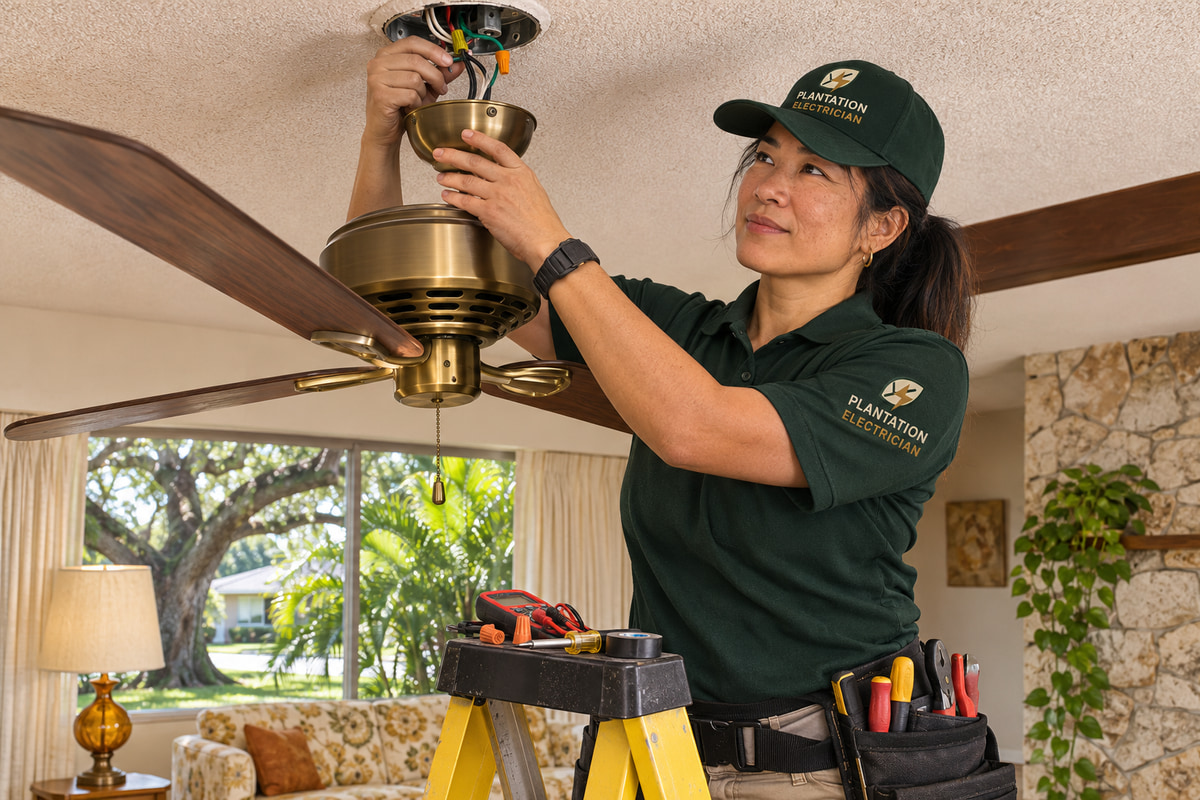
A third example involves a mid century house after a purchase. The new owners want to know if anything needs attention before moving in. A general inspection by an electrician turns up a handful of items: two outlets in the bathroom without ground fault protection, a loose lug in the panel, a garage circuit with no protection at all and a ceiling fan wired to a box not rated to hold it. Each is addressed in order of importance, and the owners receive a written list of what was done and what to plan for in the next few years. Having a calm baseline like this is one of the best reasons to book a visit before trouble begins.
Also keep in mind that boats and their shore power cords bring their own wear: a cord that is cracked, a plug that is burned or an adapter that is overheated at a dock outlet should be replaced promptly and reported to a qualified professional. Another habit helps in this climate: after any heavy rain, walk the outside of the property and look at covers, fixtures and the meter. A few minutes after a storm tells you more than hours of worry in advance, and it gives you a clear list for the next call.
Fort Lauderdale is a city of water, history and constant change, and its buildings reflect that mix. With a clear description and a calm approach, electrical work here is a manageable project. Keep records, ask questions, and treat small warnings as useful information.
Settings across Fort Lauderdale
The city offers several distinct building settings, and the right electrical approach follows the setting.
- Canal and waterfront lots. Properties where salt, moisture, docks and flooding shape the work.
- Older neighborhoods. Mid century houses where renovation and aging wiring are the main topics.
- Newer construction. Larger homes with modern protection, smart features and bigger service needs.
- Downtown buildings. Units and tenant spaces where ownership boundaries guide the work.
Nearby communities and related reading
Fort Lauderdale neighbors Lauderdale Lakes, Wilton Manors and Oakland Park, and Margate lies farther north. Our page on ceiling fan and lighting installation covers a common renovation task, and the guide on what homeowners can safely do themselves draws a clear line between simple tasks and professional ones.