

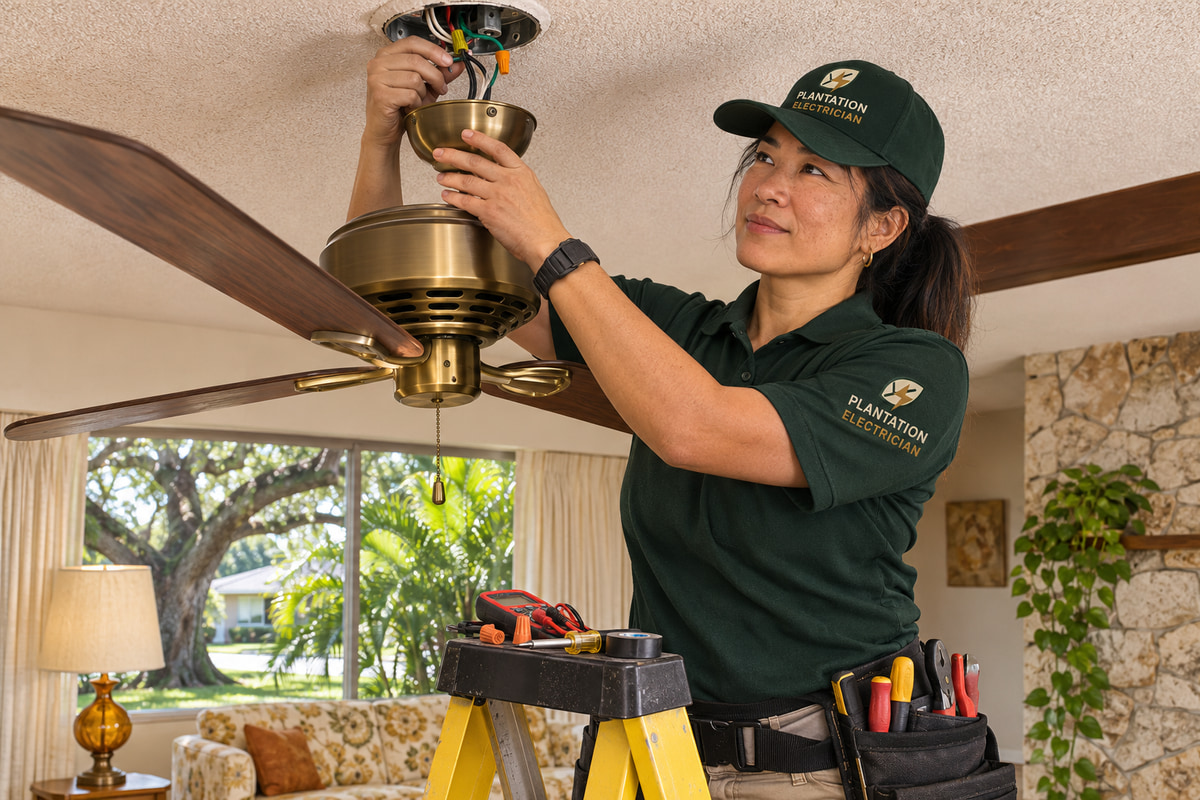
Reading the neighborhoods on both sides of the road
Nob Hill Road runs north and south through and near Plantation, and like most roads of its kind it ties together neighborhoods that were built at different times. Some streets off it are quiet residential blocks, some are townhome or villa groups, and some end in small commercial plazas. This page is a general guide for homes and small businesses near the road. It describes patterns, not particular buildings, and it is meant to help you ask better questions of any electrician you call.
A north and south road also tends to act as a boundary. Communities on one side may have been planned by one developer and communities on the other by another, which can mean different layouts, different lot sizes and different electrical habits. Two houses a few blocks apart may have panels in different spots, different kinds of fixtures, and different ways of handling the garage and lanai. We treat each property as its own, and we start by looking rather than assuming.
Age is the first thing to figure out. Homes in this part of Broward County cover a wide range, and many older ones have gone through at least one round of changes: a room added, a garage converted, a pool installed, a kitchen redone. Every change layers new wiring onto the old, and the result can be a system that works but is hard to read. A walk through with a qualified electrician often turns up things the owner never knew were there.
Newer homes are not immune from questions. Modern houses often carry many more circuits and more built in protection, but they also carry more electronics, larger air conditioners and sometimes charging for vehicles. A panel that looks generous on paper can be full in practice. The point is not that anything is wrong, only that the right moment to learn what your system can handle is before you add the next big load, not after something trips on a hot afternoon.
Whatever the age, an electrical system tends to show its condition through small signs: a switch that feels warm, lights that flicker, a breaker that trips in the heat, a faint buzz at the panel. These are easy to ignore because nothing is broken yet. We encourage people to mention them anyway, since they are often the earliest and clearest clues a qualified electrician can follow, and they usually lead to a simpler fix when caught before a failure.
Planned communities, associations and shared rules
Many neighborhoods along roads like this are planned communities with an association. Associations often set rules about exterior lights, fences, generators, charging equipment, and the colors and styles of what can be seen from the street. Before planning outdoor electrical work, check what your association requires, since some projects need an application and approval before anyone starts. Getting that in writing early saves a lot of back and forth later, and it keeps the contractor from guessing.
Associations also tend to own the shared electrical: entry gates, monument lighting, pool house power, irrigation controllers and walkway lights. If one of these fails, the association or its manager is usually the party to call. We can look at a shared system and describe what we find, but the work needs board approval and clear instructions on who schedules access. Our page about serving the city of Plantation explains how we begin any visit.
Townhomes and villas present the tightest layouts. Units share walls, and sometimes shared attic space and exterior meters. Running new wiring may involve routes that cross into a neighboring unit, which needs agreement and often approval. A good plan keeps all wiring within your own unit and uses the paths that already exist. When walls are block and the attic is limited, planning the route first saves time on the day of the work and avoids damage to finished surfaces.
Adding an electric vehicle charger is a popular example of where rules and wiring meet. The charger needs a dedicated circuit, the panel needs room, the cable needs a route to the garage or parking spot, and the association may need to approve the location. In a villa or townhome, the parking spot may not even be attached to your unit. Our page on electric vehicle charger installation covers the technical side, and the association question should be settled first.
Generator and storm preparation raise similar questions. Some communities restrict where a portable unit can be run or stored, and fuel storage and noise are common concerns. A transfer switch or inlet installed by a qualified electrician with a permit can be a cleaner approach than extension cords through a window. Rules differ, so ask your association what is allowed, and tell us what you learn so the plan fits both the electrical code and the community.
Pools, lanais and garages: where Florida homes work hardest
In this part of Florida, the parts of a house that work hardest are often outside the living room. The lanai holds fans, lights, speakers and outlets. The pool area holds a pump, a heater or chiller, lights and a bonding system that ties metal parts together. The garage holds a freezer, a workbench, a second refrigerator, and often the panel. Each of these areas faces moisture, heat and temperature swings that indoor rooms never see.
Pool equipment deserves careful attention. Pumps, heaters, lights and automation run on circuits that must be properly protected and tied into the bonding system, and age shows up as corroded connections, tripped protection and odd tingling or buzzing near water. If you ever feel a tingle in the pool or near metal around it, get everyone out of the water and keep them away until a qualified electrician has checked the system. Do not try to test it yourself.
Lanais are comfortable but hard on fixtures. Humid air, rain blown in by wind, and salt carried inland can corrode fan housings, switch plates and fixtures meant for dry rooms. Using wet rated or damp rated parts outdoors, with covers that close over plugs, makes a real difference. Our page on ceiling fan and lighting installation explains the importance of matching fixtures to the location, particularly for fans that run all day.
Garages hold a surprising amount of load. A chest freezer, a second refrigerator, a washer, a workshop with power tools, an air compressor and sometimes a charger can share a handful of circuits that were meant for far less. Outlets in garages should be ground fault protected, and cords should not be strung across the floor. If a breaker trips every time you use a tool, that is a sign the circuit is carrying more than it should.
In concrete block homes, adding outlets or lights outside is often easier through the attic or along the exterior than through the walls. Our page on block construction homes and wiring access explains the options. A qualified electrician can show you what is practical at your house before any work begins, and which routes would be neat and which would leave visible surface conduit you may not want.
Small plazas and storefronts at the intersections
Where a road like this meets a cross street, small plazas and storefronts often appear. These tend to be single story buildings with a row of suites, each with its own meter or panel, shared parking and a pole sign. The suites turn over with the economy: a food shop for a while, a salon next, an office after that. Each tenant arrives with equipment that the original wiring never anticipated, and the electrical system has to catch up.
Tenants should find out what power their suite really has before signing. Ask about the size of the panel, how many circuits are open and whether the equipment you plan to use can run without upgrades. A food service business, a nail salon, a clinic and a retail shop all have very different needs, and a quick conversation with a qualified electrician before the lease is signed can prevent an unpleasant surprise afterward.
Landlords benefit from the same thinking. A suite with a labeled panel, an accurate directory, clean wiring above the ceiling and working emergency lights is easier to rent and easier to keep safe. Over time, tenant improvements pile up, and mystery wiring is common. When one suite is vacated, it is a good moment to check what is there and tidy it up, before the next tenant moves in and adds their own changes on top.
Shared systems need care. Parking lot lights, pole signs, exterior outlets and common area lighting usually belong to the landlord, and they age as one group. When one light fails, others of the same age may not be far behind. Planning replacements in groups, with fixtures rated for the location, tends to make more sense over time than patching one at a time, and it keeps the lot evenly lit for customers and staff.
Whenever a storefront changes hands, a permit may be needed for the new work, and the city building department sets the rules. Do not assume the previous tenant had everything permitted. Ask what has been done and what documents exist. A qualified electrician can inspect the space and explain what is there and what would be needed. Our page on commercial tenant buildout electrical work describes how a changing space is evaluated.
Four ordinary situations and how we think them through
Sometimes the easiest way to explain how we work is with examples. These are made up composites that reflect common situations along roads like this, not accounts of particular customers. They show the questions we ask and the order we ask them in. If one sounds like your situation, it may help you describe it when you call, even though the details of your house will always be different from the example.
Picture a family with a house on a quiet street off the road. The air conditioner trips the breaker on the hottest afternoons. We would ask how old the unit is, whether the breaker trips immediately or after a while, and whether lights dim first. We would check the connections and the circuit, and compare what the unit needs to what the circuit supplies. Sometimes the unit is the problem, sometimes the wiring, and the visit tells us which.
Picture a retired couple in a villa who want to stay put. Their hallway is dim, an outlet is behind a heavy dresser, and the smoke alarms chirp at night. We would walk through at their pace, note what they find hard, and offer a short list sorted by priority: alarms and lighting first, outlets next, bigger changes later. Nothing needs to be done all at once, and the plan can follow how their needs change.
Picture a new tenant in a small suite who plans to open a food counter. The suite has a panel that seems full and a tangle of cords behind the counter. We would ask for the equipment list, check the panel and circuits, and say plainly what is possible within the space and what would need an upgrade, a permit or the landlord approval. The tenant can then decide how to proceed before spending on equipment that may not fit.
Picture a homeowner with a lanai that was enclosed some time ago, a ceiling fan that wobbles and a switch that crackles. We would look at how the fan is mounted and what box holds it, whether the switch is rated for the load, and whether the wiring in that room was extended in the past. Often the fix is simple, but the visit makes sure nothing hidden is waiting behind the ceiling or inside the wall.
Summer heat and storm season along an open road
A road with open sky around it takes storms head on. Lightning, wind and heavy rain all arrive without much shelter, and the utility lines nearby respond to what the weather does. Even when a storm passes without damage to the house, surges can travel through lines and leave a trail: dead electronics, a router that will not start, an air conditioner board that fails weeks later. Our page on getting your electrical system ready for hurricane season lays out a calm preparation plan.
Heat is the quieter stress. Summer afternoons push air conditioners hard, attics get very hot, and any weak connection in a breaker or outlet gets hotter than it should. Many calls we hear in July and August start with a warm plate or a smell of hot plastic. Stop using the device, switch it off, and call a qualified electrician. If you see smoke or sparks, or smell burning, leave the area and call 911 first.
Plan for power outages before they happen. Know where your main breaker is without opening anything, keep flashlights and chargers ready, and decide where you will put a portable generator, if you use one, so it runs outdoors and well away from windows and doors. Never connect a generator to a house by plugging it into a wall outlet. A qualified electrician can install a proper inlet and transfer switch with the right permit.
After a storm, be careful about what you switch back on. If water entered a garage, a pool equipment pad or a lower floor, do not touch the equipment, and do not walk through standing water near outlets or panels. Wait until power is off for that area and a qualified electrician has looked at it. Wet electrical gear often must be replaced, not dried and reused, and that surprises many owners.
Afterward, talk about the lessons. Which breakers tripped, which lights flickered, what the outage was like, what equipment failed. Those notes make a visit more useful, and they help decide whether to add surge protection, a generator connection or a panel change. Preparation does not need to be dramatic. A few sensible steps, taken before storm season starts, are usually enough to make the next one feel much more manageable.
Making a visit useful from the very first call
A visit goes smoothly when you can tell us a bit about the property in advance. We will ask whether it is a house, villa, townhome or commercial space, roughly how old the building feels, what changes have been made, and what you have noticed. You do not need technical words. Saying the kitchen lights dim when the microwave runs is exactly what we need, and it points us toward the right place to look.
On site, we look first at the service and panel, then at the circuits involved, then at the specific problem. We explain in plain language what we see, what we recommend and what can wait. If a permit is needed, we say so, and we explain that the city building department sets the requirements and inspections. Nothing is hurried, and you are welcome to ask why we recommend something, as often as you like.
Estimates are written so you can follow them. They separate the repair, the upgrade and any optional extras, and say what could change the scope once walls or ceilings are opened. You decide what to approve. If your project includes a panel change, a new circuit or an outdoor installation, we will explain the sequence, including when power will be off and for how long, so you can plan around it.
Compare electricians sensibly. Ask what they will check first, how they handle permits, what could change the scope, and how they communicate their findings. Be wary of anyone who diagnoses a serious problem over the phone with no visit, or who tells you to open a panel and look yourself. Safe electrical work begins with careful looking, and some of it is simply deciding not to touch what should be left alone.
If you live or work near Nob Hill Road and something about your electrical system has been bothering you, we would like to hear about it. Describe what you have seen and what you would like to change, and we will talk through the next step. Whether it is a warm outlet, a crowded panel or a plan for a charger or a lift, a short conversation is a good place to begin, and a visit follows only if the job calls for one.
- Whether it is a house, villa, townhome or commercial suite
- What you noticed and when it happens
- Any additions, pool work or equipment added since the building was finished
- Whether an association or landlord must approve the work
- Photos of what you can see without opening anything