

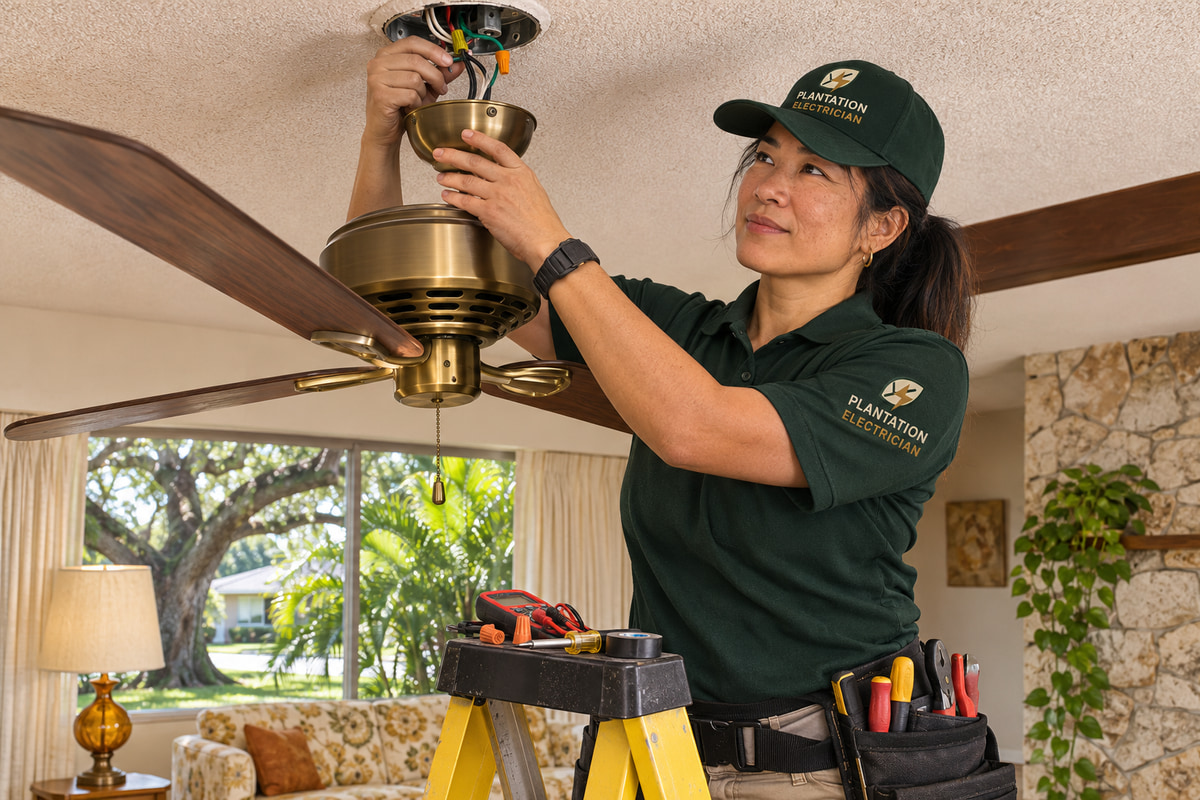
Subdivisions of different ages on both sides of one road
Pine Island Road runs north and south through Plantation. Subdivisions of varied ages sit on both sides, and shopping centers dot the corridor. That description captures something useful for anyone planning electrical work: you cannot assume the age of a house from its position on the road. Travel a few hundred yards and the era can shift by a decade or more. One subdivision may have gone up when the area first filled in, and its neighbor across the road may be much more recent.
This matters because the age of a house predicts so much about what is behind its walls. Panels, wiring materials, outlet types, and even the number of circuits all track the building practice of the time. A conversation about an electrical problem is far more useful when it begins with the approximate age of the house. A homeowner who says the house was built in the 1970s gives the electrician a head start, and one who says it was built more recently gives a different one.
The shopping centers along the corridor serve the surrounding subdivisions. They hold groceries, restaurants, service shops, medical offices and more. The tenants in these centers have electrical needs that depend on the kind of business, and the center itself has a distribution system that may be older or newer than the tenants' equipment.
For residents, the corridor offers convenience and a familiar rhythm. For electricians, it means variety within a short distance. A morning call might concern a panel in a mid century ranch, an afternoon call a lighting problem in a strip center, and an evening call a charger for an electric vehicle in a newer subdivision. The consistent thread is method: gather information, look carefully, explain clearly, and fix the cause.
This page uses only commonly known facts: that the road runs north and south, that subdivisions of varied ages lie on both sides, and that shopping centers dot the corridor. It does not describe specific streets, businesses or builders. The rest is general education about how homes and small businesses of different ages tend to behave electrically. If something here matches your situation, take it as a prompt for questions rather than a diagnosis.
A practical tip to begin: before calling, find out when your home was built. County property records, closing documents or the original inspection report usually give the year. Knowing it makes the first conversation faster and more accurate, and it helps decide whether the visit should focus first on the panel, the attic wiring or the outdoor service.
Telling the eras apart from the inside
Even without records, you can learn a good deal about a home's electrical vintage with a few safe observations. None require opening anything.
Look at the outlets. Two slot outlets suggest older wiring, with no ground at the box. Three slot outlets are common in later construction, though some are simply replaced devices on ungrounded circuits. A small plug in tester available at hardware stores shows whether an outlet is grounded and wired correctly. If it reports an open ground on a three slot outlet, the outlet was likely replaced without adding a ground, and it deserves attention.
Look at the panel cover. Do not remove it. Just look. A fuse box, with round screw in fuses or cartridge fuses, indicates older construction or an unchanged system. A breaker panel with a modest number of spaces suggests mid era construction. A panel with many spaces and neatly arranged breakers suggests newer work or a renovation. Labels on the door, if legible, show how circuits are divided.
Look at the switches. Toggle switches that click firmly are older and often long lasting. Rocker style switches and dimmers are more recent. Switches that are warm or hum should be replaced.
Look at the fixtures. Fluorescent boxes in kitchens and utility rooms hint at an earlier era. Recessed lights suggest a renovation or later construction. Bathroom fans of an older type may be noisy and inefficient.
Look at the exterior. The meter base and service mast say much. A mast that leans, a rusted base, or a bundle of old cable with taped splices at the weatherhead tells you the service has aged. Newer homes often have underground service, with a neat meter base and no overhead drop.
Look at the smoke alarms. Hardwired and interconnected alarms point to a newer or updated home. Battery only units are common in older ones. Alarms have a date printed on the back, and they should be replaced at the interval the maker recommends.
Once you gather these clues, a pattern emerges. A house with fuses, two slot outlets and fluorescent kitchen fixtures is likely a candidate for a broad review. A house with a breaker panel, grounded outlets and recessed lighting may need only targeted work. A home with some features of each has probably been renovated in stages, and the key question is whether the unseen parts were updated along with the visible ones.
Remember that appearance can mislead. A kitchen with a stylish new look may sit on wiring from the original era, and a plain looking house may have had a careful panel upgrade. That is why a proper inspection is worth more than a look from the doorway.
Tenants in the shopping centers along the road
Shopping centers along a road like this serve the daily needs of the surrounding subdivisions. Tenants include grocery and convenience stores, restaurants and takeout counters, dry cleaners, pharmacies, nail and hair salons, tutoring centers, fitness studios, and small offices. Each has a distinct electrical personality.
A takeout restaurant is a heavy and continuous user, with fryers, grills, refrigeration, hood fans and lighting all running. A dry cleaner uses presses, steam equipment and compressors. A nail salon has many small tools and lights and often a shared water heater. A tutoring center is light on equipment but heavy on computers and charging. A fitness studio might have audio and video equipment and bright lighting. A convenience store has refrigeration cases, ice machines, lottery and payment equipment, and long hours.
For each tenant, an electrician starts from the nameplates and the layout. What are the connected loads? Which run continuously? Which are 240 volts and which 120? How does the existing panel compare? Where are the shut offs? The answers produce a plan that may include new dedicated circuits, panel changes, lighting improvements, and surge protection.
Shopping center specifics add complexity. Tenant panels are often fed from a landlord's meter bank or a separate meter, and the main service for the center may have limited capacity. A tenant wishing to add large equipment must discuss capacity with the landlord. In older centers, roof access, electrical room access and conduit routes may be limited, so planning around them is part of the job.
Exterior elements belong to the center as a whole. Parking lot lights, facade lights and monument signs are generally managed by the landlord, with separate circuits and controls. Tenant signs on the building facade connect to tenant circuits, but their installation involves landlord approval and coordination with the sign installer.
Outages in shopping centers have a ripple effect. If a feeder fails or a main breaker trips, several tenants lose power at once. Tenants should know who to call: the property manager first for center wide issues, and their own electrician for problems inside their space. Keeping contact information handy saves time.
Opening day planning is a strong theme. New tenants often have fixed dates for opening, tied to leases, marketing and staffing. The electrical rough in and inspections are a large part of the critical path. To protect the date, begin conversations with an electrician as early as the lease signing, and share equipment lists, layouts and the landlord's requirements.
Finally, think about future flexibility. A space that is over wired a little, with spare conduit and extra panel capacity, adapts more easily to the next tenant or the next piece of equipment. That small investment can make the space more attractive to future occupants as well.
Meter bases, masts and the street side of the house
The point where utility power meets a house is one of the most important and least examined parts of an electrical system. On overhead services it consists of a mast and weatherhead, the cables, the meter base and the main disconnect. On underground services, it consists of conduit or a lateral running to the meter base. Everything inside the house depends on it.
In older subdivisions, service equipment has often been exposed to decades of sun, rain and storms. Typical issues include a mast that has loosened and leans away from the wall, a weatherhead whose seal has failed so that water runs down the cable into the meter base, rust or corrosion on the base itself, and splices at the weatherhead made with tape instead of proper connectors. Insect nests inside the meter base are another known trouble spot; they can cause poor contact and arcing.
Signs to watch for include a flickering or intermittent supply, a hum from the meter, heat or discoloration around the base, water stains inside the base cover, and a mast that moves when the cable sways. Any of these warrants a call. Do not touch or open the meter base; the utility seals it for a reason, and the conductors inside are live at the full service level. Work on the utility side belongs to the utility. Work on the customer side requires coordination: the utility often needs to disconnect and reconnect service for certain repairs, and permits may apply.
Surge protection is commonly added at or near the service equipment. A surge protective device at the panel shunts voltage spikes away from the house wiring. It is only as good as its installation and grounding, so correct connection to a sound grounding system is essential.
Grounding itself deserves a look. The grounding electrode, usually a rod driven into the earth or a connection to a buried water pipe, connects the system to the earth. Rods corrode, clamps loosen, and pipe connections become unreliable when plumbing is changed. A weak ground undermines surge protection and safety. A visual check and a measurement by a qualified electrician are inexpensive compared with the risk.
In neighborhoods with mature trees, the service drop may touch branches. Trimming near energized lines is for qualified tree workers coordinated with the utility.
If you plan major changes such as a bigger air conditioner, an electric vehicle charger, a pool or a generator connection, the service should be reviewed first. Sometimes the existing service is plenty. Sometimes it needs an upgrade to a larger meter base, mast and panel, a project that involves the utility, the permit office and a qualified electrician. Starting the conversation early shortens the timeline, since utility scheduling can take time.
Newer homes and the things they still need
It is easy to assume that a newer home needs nothing. In reality, newer homes have their own list of electrical wishes, and they tend to be about adding rather than repairing.
The most common request is a charger for an electric vehicle. A newer home often has a panel with room for a dedicated circuit and a garage not far from the panel. Planning includes the charger's rated current, the distance to the panel, wire size, the type of outlet or hardwired connection, and a disconnect if required. The household may want to choose a location that suits both current and future vehicles.
Next come outdoor living improvements. Patios, pools, outdoor kitchens and covered lanais call for circuits, protected outlets, lighting and fan wiring. A new home may have rough in provisions for some of these, but many were never completed. It helps to plan outdoor circuits as a group so that conduit trenches are dug once.
Whole house surge protection is another popular addition. Even new wiring is vulnerable to surges, and the sensitive electronics in a modern home, from appliances with control boards to routers and televisions, are costly to replace.
Generator readiness is a frequent request in a hurricane region. A home can be prepared with a transfer switch or interlock and an inlet on the exterior, allowing a portable generator to power chosen circuits safely. The choice of which circuits to include is a household decision: refrigerator, freezer, a few lights, some outlets, perhaps a window or central air unit if the generator is large enough.
Lighting improvements follow. Newer houses often have builder grade fixtures and sparse lighting. Adding recessed lights, under cabinet lights, pendant fixtures and dimmers changes how rooms feel. Exterior lighting for security and appearance, with timers or sensors, is another popular upgrade.
Home offices, media rooms and workshops introduce data, power and sound considerations. Dedicated circuits, extra outlets, and network cabling make these spaces functional. Planning during construction or before the walls are finished is easiest, but retrofits are possible with the right techniques.
Safety checks remain worthwhile. Test protective devices monthly, check smoke and carbon monoxide alarms, and have the panel inspected if you notice anything unusual. Newer does not mean it will never need attention. Loose connections can occur in any panel, and workmanship varies, so a periodic look at the panel, the outdoor receptacles and the surge devices is a sensible habit even in a house only a few years old. If something seems off in a newer home, trust that instinct and ask for an inspection.
One last point is documentation. Keep the builder's electrical information, permits and any manuals together. They become valuable when you add circuits or sell the home.
Booking work without guesswork
Whether you are in an older subdivision, a newer one, or a shopping center, a few steps make the process smoother.
Gather the facts. Know the approximate age of the building, the type of panel if you can see the cover, and what you have noticed. For a business, add the equipment list and any lease terms about electrical work.
Call and talk. Describe the situation. A quote comes after the conversation, and for anything beyond a simple task, a visit comes before it. Prices are never guessed, because older and layered buildings hide surprises.
Prepare for the visit. Clear access to the panel, attic hatch and any equipment in question. Be ready to say when the trouble happens and what was running. If you rent, get approval from the owner for the work and the visit.
Expect an explanation. The electrician should walk you through what was found, rank it by urgency, and describe the options. Ask what happens if you wait. Ask what could change the plan once walls are opened.
Plan the work. Agree on scope, schedule, how power outages will be handled, and who arranges permits and inspections. For a business, agree on hours that protect customers.
Watch the testing. At the end of the job, protective devices and new circuits are tested, and you should see it. The panel directory is updated. You receive notes on anything to monitor.
Keep records. A photo of the panel, copies of permits and a note of what was done are worth saving.
Here is a short example to close. A family in a house from the 1980s near the road calls because the kitchen breaker trips whenever the toaster oven and coffee maker run together. The electrician asks about the age of the house, which breaker trips and what else is on it. At the visit, the kitchen counter is found to be on one circuit shared with the dining room outlets. The solution is a second counter circuit, protected appropriately, run through the attic, and the old circuit is relabeled. The family leaves with a short note on what each breaker serves.
The same method serves a shopping center tenant: ask what changed, trace the circuit, fix the cause, test it, and write it down. That is the whole job, and it works on every kind of property this road passes.
A second example involves a newer subdivision home whose owners add a pool. The pump, a heater and a light each need circuits, and the equipment pad needs correct bonding. Before anything is ordered, the electrician checks whether the panel has the spaces and the capacity, looks at the distance from panel to pad, and talks through where the disconnect will go so it is in sight of the equipment. If the panel is nearly full, a subpanel near the pad solves both the distance and the space problem. Permits and inspections are part of a pool project, and the sequence matters because bonding must be inspected before concrete or pavers cover it. Planning the electrical side first keeps the schedule honest and avoids the expensive surprise of discovering, after the deck is poured, that a conduit was never run.
What we are often asked about on this road
Calls from around the corridor often include these requests.
- Panel and service reviews. Deciding whether aging equipment suits the home or shop.
- Kitchen and laundry circuits. Relieving overloaded circuits in houses of every age.
- Electric vehicle chargers. Dedicated circuits in newer and older garages.
- Tenant space changes. New circuits and lighting for shopping center tenants.
- Meter base and mast repair. Fixing leaning masts and corroded bases.
- Storm readiness. Surge protection and generator connections.
Other nearby areas
The University Drive corridor and the Peters Road area both lie within reach of Pine Island Road, and each has its own page here. The Sawgrass Expressway edge of west Plantation is also close. If your street or building matches one of those descriptions better, that page may be a better starting place.